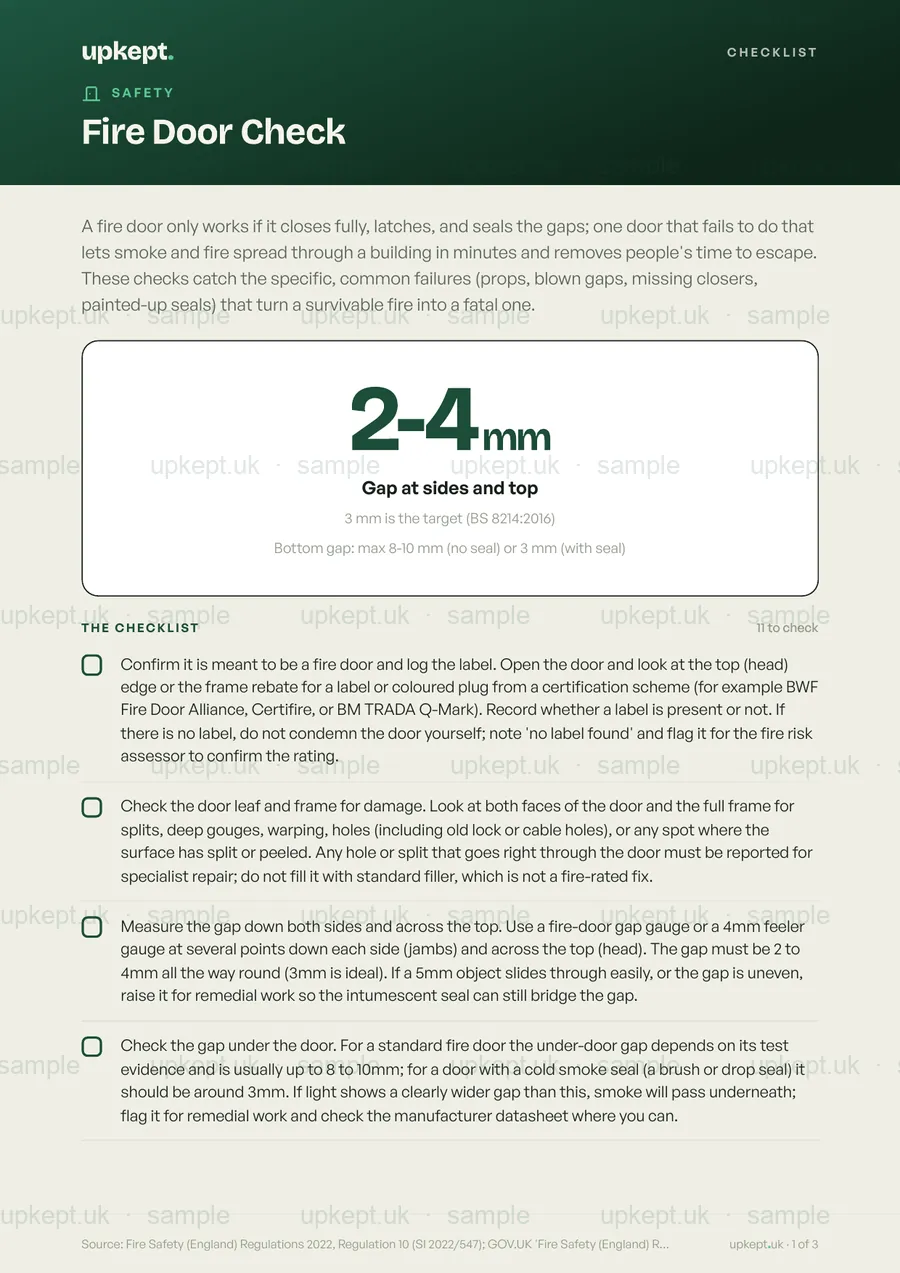
A fire door only works if it closes fully, latches, and seals the gaps; one door that fails to do that lets smoke and fire spread through a building in minutes and removes people's time to escape. These checks catch the specific, common failures (props, blown gaps, missing closers, painted-up seals) that turn a survivable fire into a fatal one.
11 checksPDF + phoneReviewed August 2026
Built on published UK guidance Show sources
Fire Safety (England) Regulations 2022, Regulation 10 (SI 2022/547); GOV.UK 'Fire Safety (England) Regulations 2022: fire door guidance' and 'Fact sheet: Fire doors (regulation 10)', Home Office; Regulatory Reform (Fire Safety) Order 2005, Article 17 (duty to maintain); BS 8214:2026 (timber fire door assemblies, gap tolerances 2 to 4mm at head and jambs); BWF Fire Door Alliance Best Practice Guide (intumescent seals activate at roughly 200 degrees C; limited overpainting is permitted)
£14one-off, yours forever
Replaces a DIY doc, and you get every future update free when the guidance changes.
3 for 2 on documents and packs. Add 3 and your cheapest is free.
A clean one-page PDF, ready to print
Opens and ticks off on any phone
Clear, no jargon, easy to follow
Free updates whenever the guidance changes
Secure checkout30-day money-backInstant downloadNo subscriptionCard & Apple Pay
Best valueSave 42%
Or get all 56 templates
The Everything Bundle: every template today and every future one.£399 one-off, instead of £686 bought separately.
Made for places like this
What’s on it
11 things to check.
Everything that matters, nothing that does not. Here is the full list, exactly as it appears on the template.
1Confirm it is meant to be a fire door and log the label. Open the door and look at the top (head) edge or the frame rebate for a label or coloured plug from a certification scheme (for example BWF Fire Door Alliance, Certifire, or BM TRADA Q-Mark). Record whether a label is present or not. If there is no label, do not condemn the door yourself; note 'no label found' and flag it for the fire risk assessor to confirm the rating.
2Check the door leaf and frame for damage. Look at both faces of the door and the full frame for splits, deep gouges, warping, holes (including old lock or cable holes), or any spot where the surface has split or peeled. Any hole or split that goes right through the door must be reported for specialist repair; do not fill it with standard filler, which is not a fire-rated fix.
3Measure the gap down both sides and across the top. Use a fire-door gap gauge or a 4mm feeler gauge at several points down each side (jambs) and across the top (head). The gap must be 2 to 4mm all the way round (3mm is ideal). If a 5mm object slides through easily, or the gap is uneven, raise it for remedial work so the intumescent seal can still bridge the gap.
4Check the gap under the door. For a standard fire door the under-door gap depends on its test evidence and is usually up to 8 to 10mm; for a door with a cold smoke seal (a brush or drop seal) it should be around 3mm. If light shows a clearly wider gap than this, smoke will pass underneath; flag it for remedial work and check the manufacturer datasheet where you can.
5Check the intumescent and smoke seals all the way round. The seal sits in a groove in the door edge or frame. It must run continuously with no missing sections, no gaps at the corners, and no pieces hanging out. If the seal includes a smoke brush, the brush must be present and not crushed flat or clogged. A seal buried under thick or repeated coats of paint should be reported; do not pick or scrape it off yourself.
6Check the hinges: every screw in, every hinge flush. Look at each hinge (a fire door usually has three). Every screw hole must have a screw in it and the hinge must sit flat against the door and frame. Tighten any loose screws on the spot. Report any bent, worn, or packed-out hinge for replacement, because a failing hinge lets the door drop and stops it closing square.
7Check the vision panel if there is one. If the door has a glazed panel, check the glass is not cracked or missing and that the beading holding it is intact all the way round. Report any cracked or missing glass for specialist replacement; never let it be patched with ordinary glass, which removes the door's fire rating.
8Test the self-closer from a few positions. Pull the door wide open and let go without touching it; it must swing shut and the latch must click home on its own. Repeat from roughly halfway and from just a few degrees open. A door that closes but does not latch is a fail. If the closer is missing, leaking, disconnected, or the door will not latch, report it the same day.
9Push the frame to check it is fixed solid. Press firmly on the frame at the top and both sides from each side of the door. It must not flex, rattle, or pull away from the wall, and there should be no open gap between the frame and the wall. Any movement or visible gap needs professional re-fixing and fire-rated sealing before the door is signed off.
10Remove anything propping or holding the door open. Check nothing is wedging it open: a wedge, a fire extinguisher, a bin, tape over the latch, or a hook. Holding a fire door open like this breaks fire safety law (Regulatory Reform (Fire Safety) Order 2005). Remove it straight away and record what you found and who you told. If the door genuinely needs to stay open, it must be on an approved automatic hold-open device linked to the fire alarm, not a prop.
11Write up every door before you leave it. Record the date, the door's location or reference number, your name, a pass or fail for each check above, and any action taken or reported. The Fire Safety (England) Regulations 2022 (Regulation 10) require the responsible person to keep these records so compliance can be shown to the fire service on request.
Good to know
The 3-monthly fire door check is not a universal legal rule; under the Fire Safety (England) Regulations 2022 (Regulation 10) it applies only to communal fire doors in residential buildings with a storey over 11 metres (roughly 5 storeys or more), with flat entrance doors checked annually on a best-endeavours basis. Most offices and commercial premises fall under the Regulatory Reform (Fire Safety) Order 2005 instead, where the frequency is whatever your fire risk assessment justifies (commonly every 6 months, more often on high-traffic doors). One more catch: a routine check records whether a certification label is present, but GOV.UK is explicit that judging the actual fire rating is the job of the fire risk assessment, not the person doing the walk-round.
Source: Fire Safety (England) Regulations 2022, Regulation 10 (SI 2022/547); GOV.UK 'Fire Safety (England) Regulations 2022: fire door guidance' and 'Fact sheet: Fire doors (regulation 10)', Home Office; Regulatory Reform (Fire Safety) Order 2005, Article 17 (duty to maintain); BS 8214:2026 (timber fire door assemblies, gap tolerances 2 to 4mm at head and jambs); BWF Fire Door Alliance Best Practice Guide (intumescent seals activate at roughly 200 degrees C; limited overpainting is permitted)
Good to know
Questions, answered
What is the Fire Door Check?
A fire door only works if it closes fully, latches, and seals the gaps; one door that fails to do that lets smoke and fire spread through a building in minutes and removes people's time to escape. These checks catch the specific, common failures (props, blown gaps, missing closers, painted-up seals) that turn a survivable fire into a fatal one.
Why does it matter?
The 3-monthly fire door check is not a universal legal rule; under the Fire Safety (England) Regulations 2022 (Regulation 10) it applies only to communal fire doors in residential buildings with a storey over 11 metres (roughly 5 storeys or more), with flat entrance doors checked annually on a best-endeavours basis. Most offices and commercial premises fall under the Regulatory Reform (Fire Safety) Order 2005 instead, where the frequency is whatever your fire risk assessment justifies (commonly every 6 months, more often on high-traffic doors). One more catch: a routine check records whether a certification label is present, but GOV.UK is explicit that judging the actual fire rating is the job of the fire risk assessment, not the person doing the walk-round.
How do I get it, and is it up to date?
The PDF downloads the moment you check out, prints sharp in black and white, and opens on any phone. It is reviewed for August 2026 and you get any future update free when the official guidance changes.
A discharged or depressurised extinguisher found during a real fire is no better than having no extinguisher at all. The monthly visual check catches the common pre-failure states (lost pressure, broken tamper seal, blocked access, overdue service) before they matter, and it gives the responsible person the maintenance records the Regulatory Reform (Fire Safety) Order 2005 requires.
An under-stocked or expired first aid kit means the person treating an injury reaches for a dressing and finds an empty slot, a perished wrapper, or latex gloves that trigger an allergic reaction. A regular documented check fixes that in advance and gives an HSE or Ofsted inspector evidence that your first aid provision is genuinely maintained, not just present.
Faulty or untested emergency lighting is one of the most common fire safety enforcement failures in the UK. These checks prove that if the mains fails during an evacuation, every escape route stays lit long enough to get people out, and that you have the dated, signed log a fire authority inspector will ask to see first.