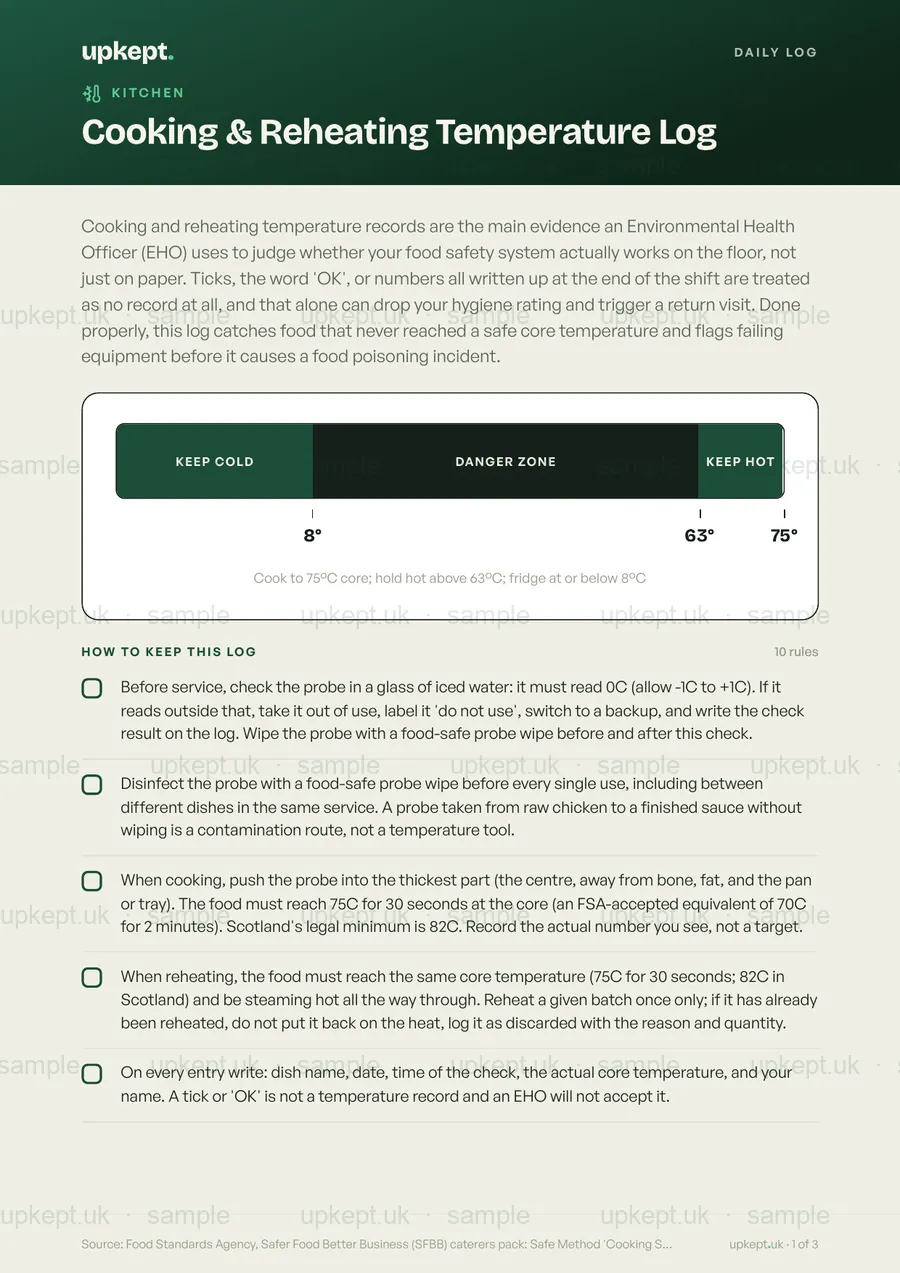
Cooking and reheating temperature records are the main evidence an Environmental Health Officer (EHO) uses to judge whether your food safety system actually works on the floor, not just on paper. Ticks, the word 'OK', or numbers all written up at the end of the shift are treated as no record at all, and that alone can drop your hygiene rating and trigger a return visit. Done properly, this log catches food that never reached a safe core temperature and flags failing equipment before it causes a food poisoning incident.
10 checksPDF + phoneReviewed August 2026
Built on published UK guidance Show sources
Food Standards Agency, Safer Food Better Business (SFBB) caterers pack: Safe Method 'Cooking Safely', 'Reheating', 'Hot Holding', 'Chilling', and 'Prove It'; plus the SFBB cooking/cooling/reheating record sheets. Cooking time/temperature equivalents and the 8C chilled-storage limit: FSA business guidance ('Chilling food correctly in your business'). Statutory hot-holding (63C) and the single 2-hour service tolerance: Food Safety and Hygiene (England) Regulations 2013, Schedule 4. Scotland's 82C reheating requirement: Food Hygiene (Scotland) Regulations 2006.
£14one-off, yours forever
Replaces a DIY doc, and you get every future update free when the guidance changes.
3 for 2 on documents and packs. Add 3 and your cheapest is free.
A clean one-page PDF, ready to print
Opens and ticks off on any phone
Clear, no jargon, easy to follow
Free updates whenever the guidance changes
Secure checkout30-day money-backInstant downloadNo subscriptionCard & Apple Pay
Best valueSave 42%
Or get all 56 templates
The Everything Bundle: every template today and every future one.£399 one-off, instead of £686 bought separately.
Made for places like this
What’s on it
10 things to check.
Everything that matters, nothing that does not. Here is the full list, exactly as it appears on the template.
1Before service, check the probe in a glass of iced water: it must read 0C (allow -1C to +1C). If it reads outside that, take it out of use, label it 'do not use', switch to a backup, and write the check result on the log. Wipe the probe with a food-safe probe wipe before and after this check.
2Disinfect the probe with a food-safe probe wipe before every single use, including between different dishes in the same service. A probe taken from raw chicken to a finished sauce without wiping is a contamination route, not a temperature tool.
3When cooking, push the probe into the thickest part (the centre, away from bone, fat, and the pan or tray). The food must reach 75C for 30 seconds at the core (an FSA-accepted equivalent of 70C for 2 minutes). Scotland's legal minimum is 82C. Record the actual number you see, not a target.
4When reheating, the food must reach the same core temperature (75C for 30 seconds; 82C in Scotland) and be steaming hot all the way through. Reheat a given batch once only; if it has already been reheated, do not put it back on the heat, log it as discarded with the reason and quantity.
5On every entry write: dish name, date, time of the check, the actual core temperature, and your name. A tick or 'OK' is not a temperature record and an EHO will not accept it.
6If a reading is below target, put the food back on the heat, wait two minutes, and probe again. If it still fails on the second check, do not serve it: log the discard with dish name, quantity, reason ('did not reach 75C after two checks'), time, and your name. This corrective-action record is the part an EHO most wants to see.
7For hot-holding (cooked food kept warm before service), probe and log the held food at least every 2 hours. The legal minimum is 63C. If a batch drops below 63C, either reheat it straight away to 75C+ and log that, or serve it within a single 2-hour window and bin the rest. Never let it sit below 63C and top it back up with fresh hot food.
8For food cooked ahead and chilled, log the time it came off the heat and the time it went into the fridge. It must drop to 8C or below within 90 minutes. Use a blast chiller, shallow trays, or an ice bath to get there; if a batch takes longer, log it as a corrective action and discard it.
9Fill in each entry as the check happens, not at the end of the shift. A sheet written up at 11pm for noon checks is a back-filled record; EHOs are trained to spot uniform handwriting and entries all made in one sitting.
10Keep completed logs for at least 3 months and have them to hand the moment an EHO asks. A phone or app log is fine if it can be shown on request and entries cannot be edited after they are saved.
Good to know
There is no single statutory cooking temperature in England, Wales or Northern Ireland. The law (Food Safety and Hygiene (England) Regulations 2013, applying Regulation (EC) 852/2004) only requires food to be cooked enough to destroy harmful bacteria, so the FSA expresses this as time-and-temperature combinations that all do the same job: 70C for 2 minutes, 75C for 30 seconds, 80C for 6 seconds, or 60C for 45 minutes. 75C/30s is the benchmark most EHOs apply. Only Scotland names a fixed legal figure: reheating to at least 82C under the Food Hygiene (Scotland) Regulations 2006. Hot-holding at 63C or above is the one temperature that is statutory UK-wide (England: 2013 Regulations, Schedule 4).
Source: Food Standards Agency, Safer Food Better Business (SFBB) caterers pack: Safe Method 'Cooking Safely', 'Reheating', 'Hot Holding', 'Chilling', and 'Prove It'; plus the SFBB cooking/cooling/reheating record sheets. Cooking time/temperature equivalents and the 8C chilled-storage limit: FSA business guidance ('Chilling food correctly in your business'). Statutory hot-holding (63C) and the single 2-hour service tolerance: Food Safety and Hygiene (England) Regulations 2013, Schedule 4. Scotland's 82C reheating requirement: Food Hygiene (Scotland) Regulations 2006.
Good to know
Questions, answered
What is the Cooking & Reheating Temperature Log?
Cooking and reheating temperature records are the main evidence an Environmental Health Officer (EHO) uses to judge whether your food safety system actually works on the floor, not just on paper. Ticks, the word 'OK', or numbers all written up at the end of the shift are treated as no record at all, and that alone can drop your hygiene rating and trigger a return visit. Done properly, this log catches food that never reached a safe core temperature and flags failing equipment before it causes a food poisoning incident.
Why does it matter?
There is no single statutory cooking temperature in England, Wales or Northern Ireland. The law (Food Safety and Hygiene (England) Regulations 2013, applying Regulation (EC) 852/2004) only requires food to be cooked enough to destroy harmful bacteria, so the FSA expresses this as time-and-temperature combinations that all do the same job: 70C for 2 minutes, 75C for 30 seconds, 80C for 6 seconds, or 60C for 45 minutes. 75C/30s is the benchmark most EHOs apply. Only Scotland names a fixed legal figure: reheating to at least 82C under the Food Hygiene (Scotland) Regulations 2006. Hot-holding at 63C or above is the one temperature that is statutory UK-wide (England: 2013 Regulations, Schedule 4).
How do I get it, and is it up to date?
The PDF downloads the moment you check out, prints sharp in black and white, and opens on any phone. It is reviewed for August 2026 and you get any future update free when the official guidance changes.
Your temperature log is the main evidence that your cold storage is actually working. A missing entry, or an out-of-range reading nobody acted on, is what turns a single fridge fault into a food poisoning case and a failed hygiene inspection. This list makes every entry a real number, taken at the right time, with the action recorded when something goes wrong.
A wrong, out-of-date, or missing allergen line can put a customer into anaphylaxis and kill them. It also breaks the Food Information Regulations 2014, where giving false or misleading allergen information is a criminal offence carrying an unlimited fine, not just a hygiene black mark. A correct matrix is what lets any team member answer "what's in this?" the same way every time.
A food safety daily diary is the written proof that your food safety system is actually being run, not just sitting in a folder. On inspection an Environmental Health Officer treats a blank or gap-filled diary as evidence the system is failing, while a complete one with real numbers is your legal defence if someone falls ill. Filled in properly it also catches a warm fridge or an undercooked batch before it reaches a customer.