Sample pages of the actual document, watermarked. The download is clean.
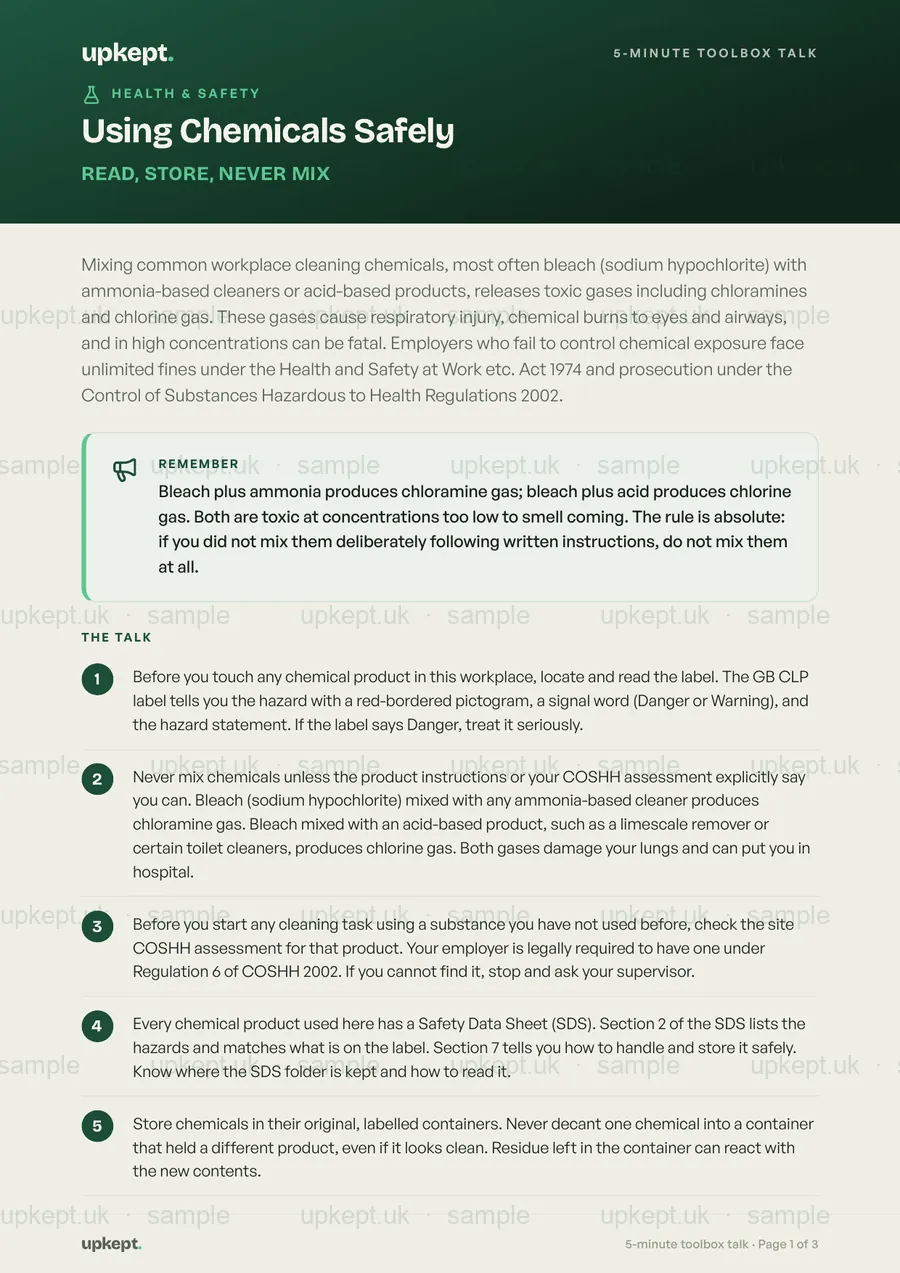
Using Chemicals Safely
Mixing bleach (sodium hypochlorite) with an ammonia-based or acid-based cleaner releases chloramines or chlorine gas, which burn the eyes and airways and can kill at high concentrations. The duty to control exposure sits in the Control of Substances Hazardous to Health Regulations 2002.
30-day money-back guarantee.
- A script to read out, no prep needed
- Questions to check the team understood
- What the law says, in clear terms
- A printed sign-off sheet, your training record
The talk
What you say, in order.
Read it out as it is, or make it your own. Either way the team hears the same thing, every time.
- 1Before you touch any chemical product in this workplace, locate and read the label. The GB CLP label tells you the hazard with a red-bordered pictogram, a signal word (Danger or Warning), and the hazard statement. If the label says Danger, treat it seriously.
- 2Never mix chemicals unless the product instructions or your COSHH assessment explicitly say you can. Bleach (sodium hypochlorite) mixed with any ammonia-based cleaner produces chloramine gas. Bleach mixed with an acid-based product, such as a limescale remover or certain toilet cleaners, produces chlorine gas. Both gases damage your lungs and can put you in hospital.
- 3Before you start any cleaning task using a substance you have not used before, check the site COSHH assessment for that product. Your employer is legally required to have one under Regulation 6 of COSHH 2002. If you cannot find it, stop and ask your supervisor.
- 4Every chemical product used here has a Safety Data Sheet (SDS). Section 2 of the SDS lists the hazards and matches what is on the label. Section 7 tells you how to handle and store it safely. Know where the SDS folder is kept and how to read it.
- 5Store chemicals in their original, labelled containers. Never decant one chemical into a container that held a different product, even if it looks clean. Residue left in the container can react with the new contents.
- 6When using cleaning chemicals in a confined space, a small room, or a poorly ventilated area, open windows and doors before you start. Ventilation is the first line of defence against vapour build-up.
- 7Wear the PPE specified on the COSHH assessment for the task: usually gloves, apron, and eye protection. PPE is the last line of defence, not the first. Controls come before PPE.
- 8If you smell something unexpected, feel burning in your eyes or throat, or feel dizzy while using a chemical product, stop immediately, leave the area, tell your supervisor, and get fresh air. Call 999 if anyone loses consciousness, has chest pain, or cannot breathe.
Ask the team
- ?If you picked up a cleaning product you had never used before, what would be the first two things you would check before using it?
- ?What are the two combinations we have talked about that produce toxic gas, and what does that gas do to your body?
- ?If a colleague complained of throat burning and eye irritation while cleaning a toilet, what would you do?
What the law says
COSHH 2002: assess it, control it, tell your team
Under the Control of Substances Hazardous to Health Regulations 2002 (SI 2002/2677), Regulation 6 requires employers to carry out a suitable and sufficient risk assessment before work with hazardous substances begins. Regulation 7 requires exposure to be prevented or, where that is not reasonably practicable, adequately controlled. Regulation 12 requires employers to provide information, instruction and training to workers who may be exposed. Breaches can result in unlimited fines in either the magistrates' court or the Crown Court under Section 33 of the Health and Safety at Work etc. Act 1974.
Source: Control of Substances Hazardous to Health Regulations 2002 (SI 2002/2677), Regulations 6, 7 and 12; HSE Approved Code of Practice and Guidance L5 (6th edition); Health and Safety at Work etc. Act 1974, Section 33
Before you buy
Questions people ask first
What is the "Using Chemicals Safely" toolbox talk?
Mixing bleach (sodium hypochlorite) with an ammonia-based or acid-based cleaner releases chloramines or chlorine gas, which burn the eyes and airways and can kill at high concentrations. The duty to control exposure sits in the Control of Substances Hazardous to Health Regulations 2002.
What does the law say?
COSHH 2002: assess it, control it, tell your team. Under the Control of Substances Hazardous to Health Regulations 2002 (SI 2002/2677), Regulation 6 requires employers to carry out a suitable and sufficient risk assessment before work with hazardous substances begins. Regulation 7 requires exposure to be prevented or, where that is not reasonably practicable, adequately controlled. Regulation 12 requires employers to provide information, instruction and training to workers who may be exposed. Breaches can result in unlimited fines in either the magistrates' court or the Crown Court under Section 33 of the Health and Safety at Work etc. Act 1974.
How do I run it, and does it count as training?
Read it out in about five minutes, ask the team the questions, and everyone signs the attendance sheet. That sign-off is your evidence of training under the Health and Safety at Work etc. Act 1974, section 2. Reviewed for October 2026.