Sample pages of the actual document, watermarked. The download is clean.
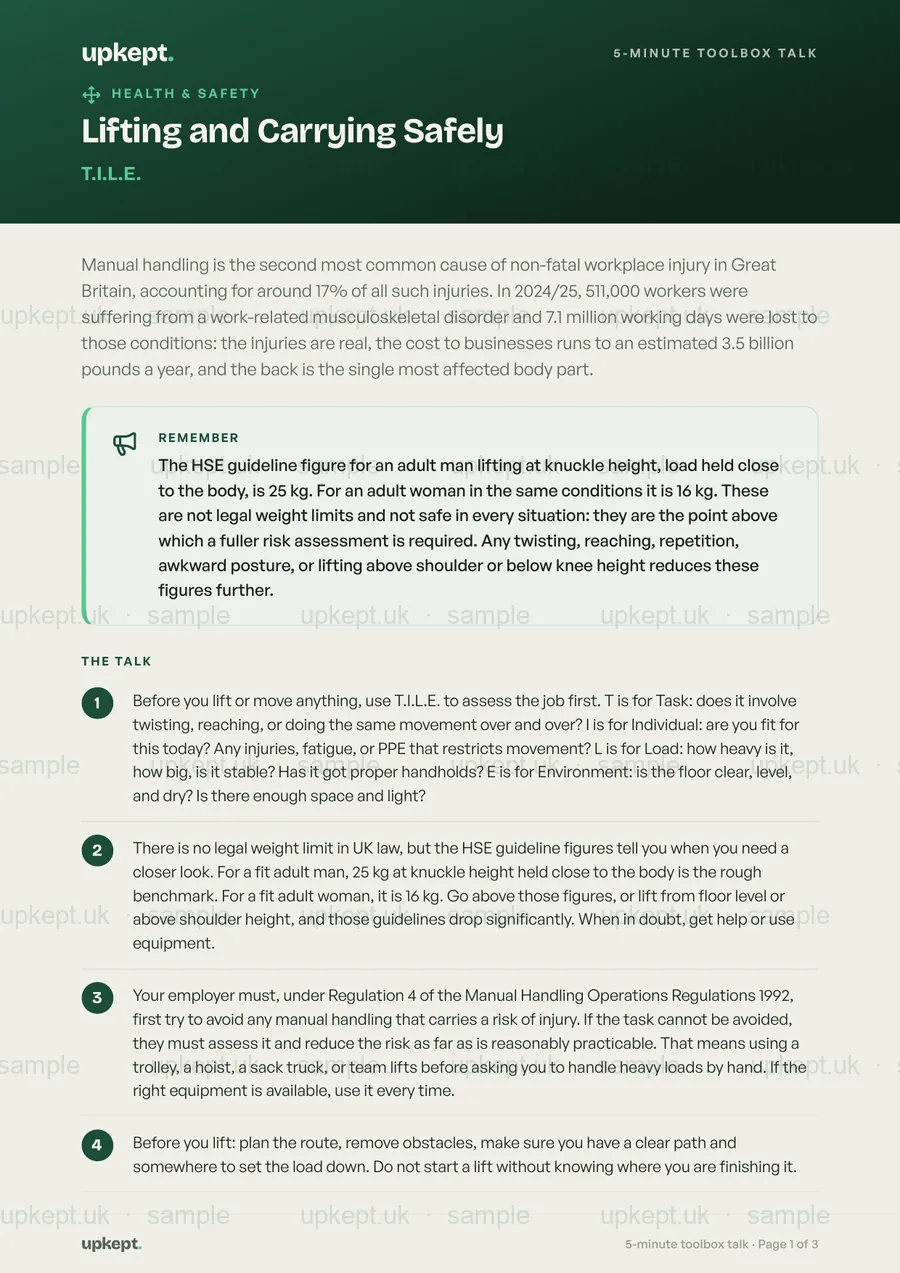
Lifting and Carrying Safely
Manual handling was the second most common cause of non-fatal workplace injury in Great Britain in 2024/25, around 17% of the total. 511,000 workers had a work-related musculoskeletal disorder that year and 7.1 million working days were lost to them. The back is the most affected part.
30-day money-back guarantee.
- A script to read out, no prep needed
- Questions to check the team understood
- What the law says, in clear terms
- A printed sign-off sheet, your training record
The talk
What you say, in order.
Read it out as it is, or make it your own. Either way the team hears the same thing, every time.
- 1Before you lift or move anything, use T.I.L.E. to assess the job first. T is for Task: does it involve twisting, reaching, or doing the same movement over and over? I is for Individual: are you fit for this today? Any injuries, fatigue, or PPE that restricts movement? L is for Load: how heavy is it, how big, is it stable? Has it got proper handholds? E is for Environment: is the floor clear, level, and dry? Is there enough space and light?
- 2There is no legal weight limit in UK law, but the HSE guideline figures tell you when you need a closer look. For a fit adult man, 25 kg at knuckle height held close to the body is the rough benchmark. For a fit adult woman, it is 16 kg. Go above those figures, or lift from floor level or above shoulder height, and those guidelines drop significantly. When in doubt, get help or use equipment.
- 3Your employer must, under Regulation 4 of the Manual Handling Operations Regulations 1992, first try to avoid any manual handling that carries a risk of injury. If the task cannot be avoided, they must assess it and reduce the risk as far as is reasonably practicable. That means using a trolley, a hoist, a sack truck, or team lifts before asking you to handle heavy loads by hand. If the right equipment is available, use it every time.
- 4Before you lift: plan the route, remove obstacles, make sure you have a clear path and somewhere to set the load down. Do not start a lift without knowing where you are finishing it.
- 5To lift safely: stand close to the load with your feet apart and one foot slightly forward. Bend your knees and hips slightly, not a full squat and not a full stoop. Get a firm grip. Keep the load tight against your body, straighten your legs in a controlled way, keep your head up and look ahead, not down at the load. Move your feet to change direction rather than twisting your back.
- 6Never twist your spine while the load is in your hands. Twisting under load is one of the most common causes of back injury at work. Turn your whole body by moving your feet.
- 7If the load is too heavy, too bulky, or the conditions are not right, stop and report it. Under Regulation 5 of the Manual Handling Operations Regulations 1992, you have a legal duty to use the safe systems your employer puts in place, and you also have every right to raise a concern before you get hurt.
- 8If you feel pain or discomfort during or after a manual handling task, report it straight away. Do not wait until it gets worse. Early reporting means early treatment and it helps the team prevent the same injury happening to someone else.
Ask the team
- ?Walk me through what T.I.L.E. stands for and tell me one thing you would check under each letter before you start a lift.
- ?If the load is too heavy to handle safely on your own, what are your options before you start?
- ?What should you do if you feel pain or discomfort during or after a manual handling task?
What the law says
Assess, avoid, and reduce: your legal duty before every lift
The Manual Handling Operations Regulations 1992 (Regulation 4) require employers to avoid hazardous manual handling wherever reasonably practicable, assess any operation that cannot be avoided using the Schedule 1 factors, and reduce the risk of injury as far as is reasonably practicable. The HSE Approved Code of Practice L23 supports these regulations and carries special legal weight: if a breach is prosecuted, failure to follow L23 can be taken as proof of contravention unless you can show you complied by equivalent means. Employees also have a legal duty under Regulation 5 to make full and proper use of the safe systems of work their employer provides.
Source: Manual Handling Operations Regulations 1992 (SI 1992/2793), Regulation 4 and Regulation 5; HSE Approved Code of Practice and Guidance L23 (fourth edition, 2016)
Before you buy
Questions people ask first
What is the "Lifting and Carrying Safely" toolbox talk?
Manual handling was the second most common cause of non-fatal workplace injury in Great Britain in 2024/25, around 17% of the total. 511,000 workers had a work-related musculoskeletal disorder that year and 7.1 million working days were lost to them. The back is the most affected part.
What does the law say?
Assess, avoid, and reduce: your legal duty before every lift. The Manual Handling Operations Regulations 1992 (Regulation 4) require employers to avoid hazardous manual handling wherever reasonably practicable, assess any operation that cannot be avoided using the Schedule 1 factors, and reduce the risk of injury as far as is reasonably practicable. The HSE Approved Code of Practice L23 supports these regulations and carries special legal weight: if a breach is prosecuted, failure to follow L23 can be taken as proof of contravention unless you can show you complied by equivalent means. Employees also have a legal duty under Regulation 5 to make full and proper use of the safe systems of work their employer provides.
How do I run it, and does it count as training?
Read it out in about five minutes, ask the team the questions, and everyone signs the attendance sheet. That sign-off is your evidence of training under the Health and Safety at Work etc. Act 1974, section 2. Reviewed for October 2026.