Sample pages of the actual document, watermarked. The download is clean.
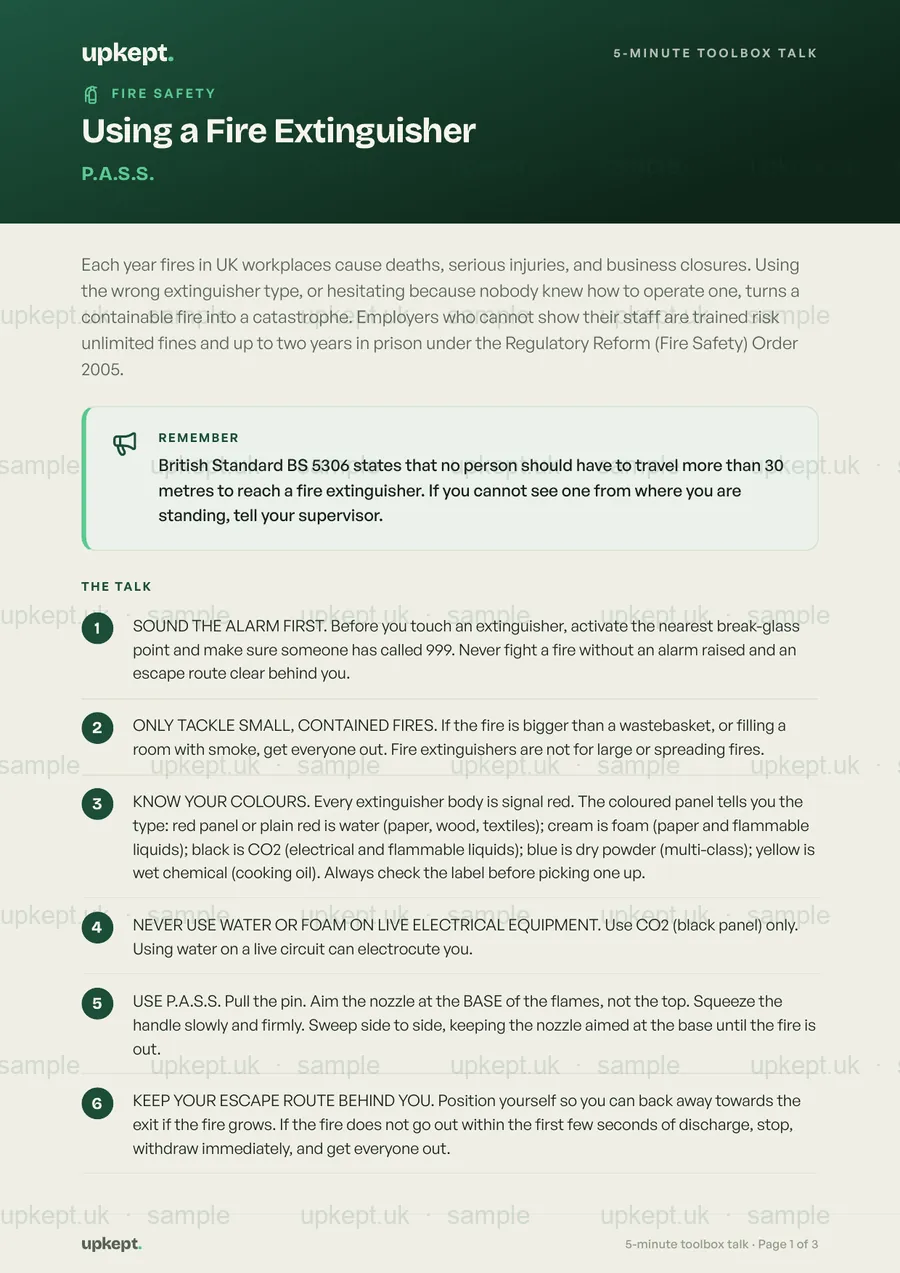
Using a Fire Extinguisher
The wrong extinguisher on the wrong fire, or a pause because nobody knew how to work one, is the difference between a bin fire and a building fire. The Regulatory Reform (Fire Safety) Order 2005 requires staff to be instructed, and a signed talk is the record.
30-day money-back guarantee.
- A script to read out, no prep needed
- Questions to check the team understood
- What the law says, in clear terms
- A printed sign-off sheet, your training record
The talk
What you say, in order.
Read it out as it is, or make it your own. Either way the team hears the same thing, every time.
- 1SOUND THE ALARM FIRST. Before you touch an extinguisher, activate the nearest break-glass point and make sure someone has called 999. Never fight a fire without an alarm raised and an escape route clear behind you.
- 2ONLY TACKLE SMALL, CONTAINED FIRES. If the fire is bigger than a wastebasket, or filling a room with smoke, get everyone out. Fire extinguishers are not for large or spreading fires.
- 3KNOW YOUR COLOURS. Every extinguisher body is signal red. The coloured panel tells you the type: red panel or plain red is water (paper, wood, textiles); cream is foam (paper and flammable liquids); black is CO2 (electrical and flammable liquids); blue is dry powder (multi-class); yellow is wet chemical (cooking oil). Always check the label before picking one up.
- 4NEVER USE WATER OR FOAM ON LIVE ELECTRICAL EQUIPMENT. Use CO2 (black panel) only. Using water on a live circuit can electrocute you.
- 5USE P.A.S.S. Pull the pin. Aim the nozzle at the BASE of the flames, not the top. Squeeze the handle slowly and firmly. Sweep side to side, keeping the nozzle aimed at the base until the fire is out.
- 6KEEP YOUR ESCAPE ROUTE BEHIND YOU. Position yourself so you can back away towards the exit if the fire grows. If the fire does not go out within the first few seconds of discharge, stop, withdraw immediately, and get everyone out.
- 7NEVER RE-ENTER AFTER EVACUATING. Once you are out, stay out. Even if you believe the fire is out, do not go back inside until the fire service declares it safe.
- 8REPORT ALL EXTINGUISHER USE. Any extinguisher that has been discharged, even partially, must be taken out of service and reported to your supervisor immediately. A used extinguisher may look full but will fail if needed again.
Ask the team
- ?If you picked up a fire extinguisher and the fire kept growing, what would you do next?
- ?Looking at the extinguishers on this floor, which one would you NOT use on a piece of electrical equipment, and why?
- ?What is the first thing you do before attempting to fight any fire with an extinguisher?
What the law says
Employers must provide firefighting equipment and train staff to use it
The Regulatory Reform (Fire Safety) Order 2005 (Article 13) requires the Responsible Person to provide appropriate firefighting equipment for the premises and ensure it is maintained. Article 21 requires employees to receive adequate fire safety training, including how to use firefighting equipment. Breach of the Order can result in an unlimited fine on summary conviction, or an unlimited fine plus up to two years imprisonment on indictment.
Source: Regulatory Reform (Fire Safety) Order 2005 (SI 2005/1541), Articles 13 and 21; Fire Safety Act 2021 (amending the 2005 Order); BS 5306-3 and BS 5306-8 (maintenance and selection of portable fire extinguishers)
Before you buy
Questions people ask first
What is the "Using a Fire Extinguisher" toolbox talk?
The wrong extinguisher on the wrong fire, or a pause because nobody knew how to work one, is the difference between a bin fire and a building fire. The Regulatory Reform (Fire Safety) Order 2005 requires staff to be instructed, and a signed talk is the record.
What does the law say?
Employers must provide firefighting equipment and train staff to use it. The Regulatory Reform (Fire Safety) Order 2005 (Article 13) requires the Responsible Person to provide appropriate firefighting equipment for the premises and ensure it is maintained. Article 21 requires employees to receive adequate fire safety training, including how to use firefighting equipment. Breach of the Order can result in an unlimited fine on summary conviction, or an unlimited fine plus up to two years imprisonment on indictment.
How do I run it, and does it count as training?
Read it out in about five minutes, ask the team the questions, and everyone signs the attendance sheet. That sign-off is your evidence of training under the Health and Safety at Work etc. Act 1974, section 2. Reviewed for October 2026.