Sample pages of the actual document, watermarked. The download is clean.
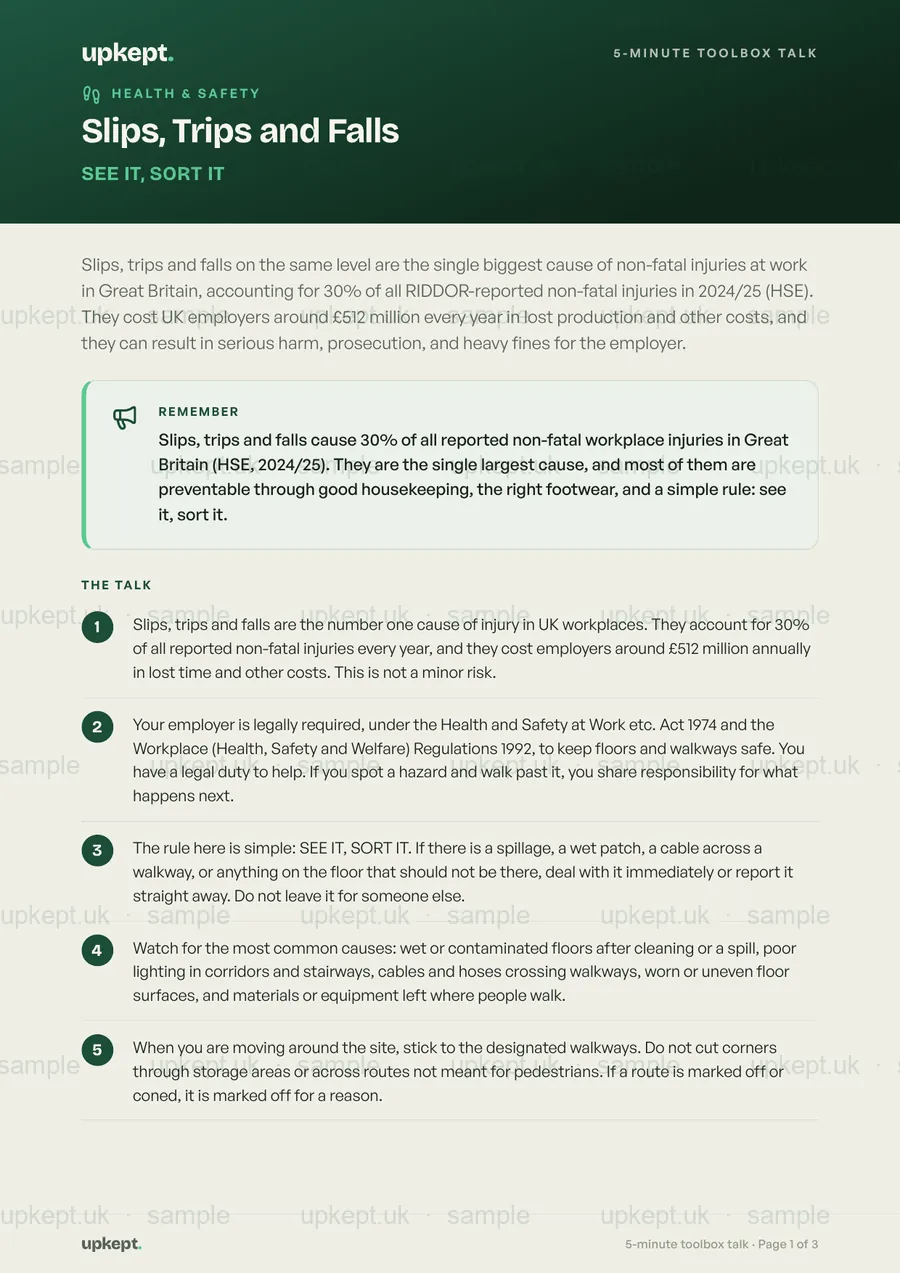
Slips, Trips and Falls
Slips, trips and falls on the same level were 30% of RIDDOR-reported non-fatal injuries in Great Britain in 2024/25 (HSE), the largest single cause. HSE puts the cost to employers at around £512 million a year in lost production and other costs.
30-day money-back guarantee.
- A script to read out, no prep needed
- Questions to check the team understood
- What the law says, in clear terms
- A printed sign-off sheet, your training record
The talk
What you say, in order.
Read it out as it is, or make it your own. Either way the team hears the same thing, every time.
- 1Slips, trips and falls are the number one cause of injury in UK workplaces. They account for 30% of all reported non-fatal injuries every year, and they cost employers around £512 million annually in lost time and other costs. This is not a minor risk.
- 2Your employer is legally required, under the Health and Safety at Work etc. Act 1974 and the Workplace (Health, Safety and Welfare) Regulations 1992, to keep floors and walkways safe. You have a legal duty to help. If you spot a hazard and walk past it, you share responsibility for what happens next.
- 3The rule here is simple: SEE IT, SORT IT. If there is a spillage, a wet patch, a cable across a walkway, or anything on the floor that should not be there, deal with it immediately or report it straight away. Do not leave it for someone else.
- 4Watch for the most common causes: wet or contaminated floors after cleaning or a spill, poor lighting in corridors and stairways, cables and hoses crossing walkways, worn or uneven floor surfaces, and materials or equipment left where people walk.
- 5When you are moving around the site, stick to the designated walkways. Do not cut corners through storage areas or across routes not meant for pedestrians. If a route is marked off or coned, it is marked off for a reason.
- 6Wear the footwear provided or specified for your role. The right sole makes a significant difference on wet or contaminated surfaces. If your footwear is worn or damaged, report it today, not next week.
- 7If you need to clean up a spill, put out a wet-floor sign first before you start cleaning, and leave it in place until the floor is fully dry. A sign without any cleaning is not good enough, and cleaning without a sign is not good enough either.
- 8If you are working near stairs or ramps, always use the handrail. Regulation 12(5) of the Workplace Regulations 1992 requires suitable handrails to be provided. Using them is not optional.
Ask the team
- ?What would you do right now if you walked past a spillage in the corridor and there was no one else around?
- ?Can anyone name three things in this workplace that could cause a slip or trip, and tell me where they are?
- ?What information do you need to report a hazard, and who do you report it to?
What the law says
Floors must be safe, clear and maintained
Regulation 12 of the Workplace (Health, Safety and Welfare) Regulations 1992 requires every floor and traffic route to be suitable for its purpose, free from holes and slippery surfaces, and kept free from obstructions and substances that could cause a slip, trip or fall, so far as is reasonably practicable. The Health and Safety at Work etc. Act 1974 (section 2) places an overarching duty on every employer to ensure the health, safety and welfare of all employees so far as is reasonably practicable. Failure to comply can result in prosecution: in 2025, British Airways was fined over £3 million following falls-related incidents at Heathrow.
Source: Workplace (Health, Safety and Welfare) Regulations 1992, Regulation 12; Health and Safety at Work etc. Act 1974, Section 2; HSE enforcement record (press.hse.gov.uk, May 2025)
Before you buy
Questions people ask first
What is the "Slips, Trips and Falls" toolbox talk?
Slips, trips and falls on the same level were 30% of RIDDOR-reported non-fatal injuries in Great Britain in 2024/25 (HSE), the largest single cause. HSE puts the cost to employers at around £512 million a year in lost production and other costs.
What does the law say?
Floors must be safe, clear and maintained. Regulation 12 of the Workplace (Health, Safety and Welfare) Regulations 1992 requires every floor and traffic route to be suitable for its purpose, free from holes and slippery surfaces, and kept free from obstructions and substances that could cause a slip, trip or fall, so far as is reasonably practicable. The Health and Safety at Work etc. Act 1974 (section 2) places an overarching duty on every employer to ensure the health, safety and welfare of all employees so far as is reasonably practicable. Failure to comply can result in prosecution: in 2025, British Airways was fined over £3 million following falls-related incidents at Heathrow.
How do I run it, and does it count as training?
Read it out in about five minutes, ask the team the questions, and everyone signs the attendance sheet. That sign-off is your evidence of training under the Health and Safety at Work etc. Act 1974, section 2. Reviewed for October 2026.