Sample pages of the actual document, watermarked. The download is clean.
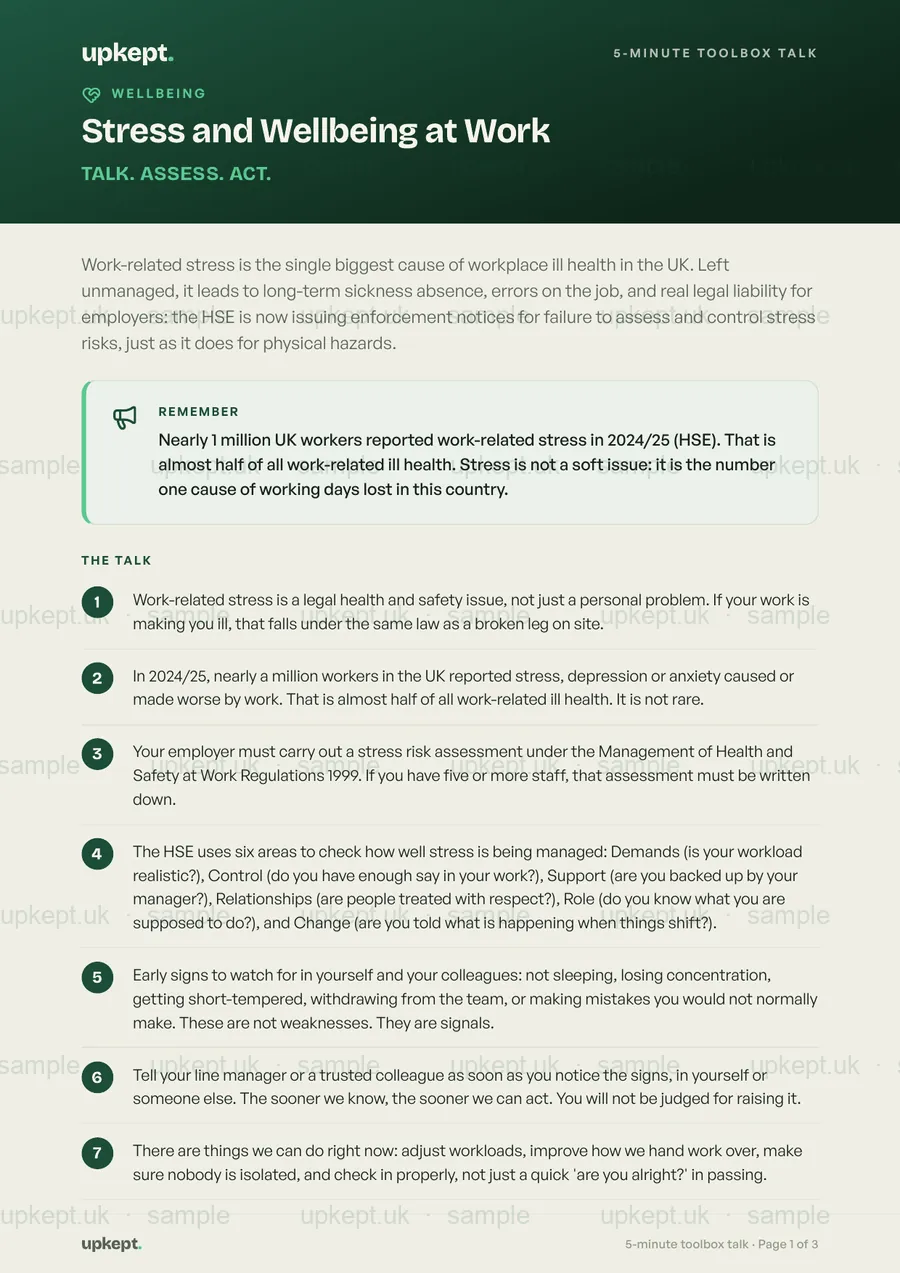
Stress and Wellbeing at Work
Work-related stress, depression and anxiety accounted for about half of all work-related ill health cases in Great Britain in 2024/25 (HSE). The HSE issues enforcement notices for failing to assess and control stress risks, as it does for physical hazards.
30-day money-back guarantee.
- A script to read out, no prep needed
- Questions to check the team understood
- What the law says, in clear terms
- A printed sign-off sheet, your training record
The talk
What you say, in order.
Read it out as it is, or make it your own. Either way the team hears the same thing, every time.
- 1Work-related stress is a legal health and safety issue, not just a personal problem. If your work is making you ill, that falls under the same law as a broken leg on site.
- 2In 2024/25, nearly a million workers in the UK reported stress, depression or anxiety caused or made worse by work. That is almost half of all work-related ill health. It is not rare.
- 3Your employer must carry out a stress risk assessment under the Management of Health and Safety at Work Regulations 1999. If you have five or more staff, that assessment must be written down.
- 4The HSE uses six areas to check how well stress is being managed: Demands (is your workload realistic?), Control (do you have enough say in your work?), Support (are you backed up by your manager?), Relationships (are people treated with respect?), Role (do you know what you are supposed to do?), and Change (are you told what is happening when things shift?).
- 5Early signs to watch for in yourself and your colleagues: not sleeping, losing concentration, getting short-tempered, withdrawing from the team, or making mistakes you would not normally make. These are not weaknesses. They are signals.
- 6Tell your line manager or a trusted colleague as soon as you notice the signs, in yourself or someone else. The sooner we know, the sooner we can act. You will not be judged for raising it.
- 7There are things we can do right now: adjust workloads, improve how we hand work over, make sure nobody is isolated, and check in properly, not just a quick 'are you alright?' in passing.
- 8If you do not feel comfortable talking to your manager, you can contact our HR team, a union rep, or the free and confidential Employee Assistance Programme. Those routes are there for a reason.
Ask the team
- ?If you were struggling with stress at work, what would stop you from telling someone, and how could we fix that?
- ?Looking at the six factors (demands, control, support, relationships, role, change), which one feels most like a problem in your area right now?
- ?What is one thing we could change in the way we work day-to-day that would take some of the pressure off?
What the law says
Employers must assess and control stress, by law
Section 2 of the Health and Safety at Work etc. Act 1974 requires every employer to protect the health, safety and welfare of employees, and that includes mental health. Regulation 3 of the Management of Health and Safety at Work Regulations 1999 requires a suitable and sufficient risk assessment of all hazards, including work-related stress. In December 2025 the HSE issued a formal Notice of Contravention to the University of Birmingham for failing to properly assess and control stress risks, showing that enforcement action now follows the same path as physical safety breaches.
Source: Health and Safety at Work etc. Act 1974, s.2; Management of Health and Safety at Work Regulations 1999, SI 1999/3242, Reg. 3; HSE Management Standards for Work-Related Stress (HSE.gov.uk)
Before you buy
Questions people ask first
What is the "Stress and Wellbeing at Work" toolbox talk?
Work-related stress, depression and anxiety accounted for about half of all work-related ill health cases in Great Britain in 2024/25 (HSE). The HSE issues enforcement notices for failing to assess and control stress risks, as it does for physical hazards.
What does the law say?
Employers must assess and control stress, by law. Section 2 of the Health and Safety at Work etc. Act 1974 requires every employer to protect the health, safety and welfare of employees, and that includes mental health. Regulation 3 of the Management of Health and Safety at Work Regulations 1999 requires a suitable and sufficient risk assessment of all hazards, including work-related stress. In December 2025 the HSE issued a formal Notice of Contravention to the University of Birmingham for failing to properly assess and control stress risks, showing that enforcement action now follows the same path as physical safety breaches.
How do I run it, and does it count as training?
Read it out in about five minutes, ask the team the questions, and everyone signs the attendance sheet. That sign-off is your evidence of training under the Health and Safety at Work etc. Act 1974, section 2. Reviewed for October 2026.