Sample pages of the actual document, watermarked. The download is clean.
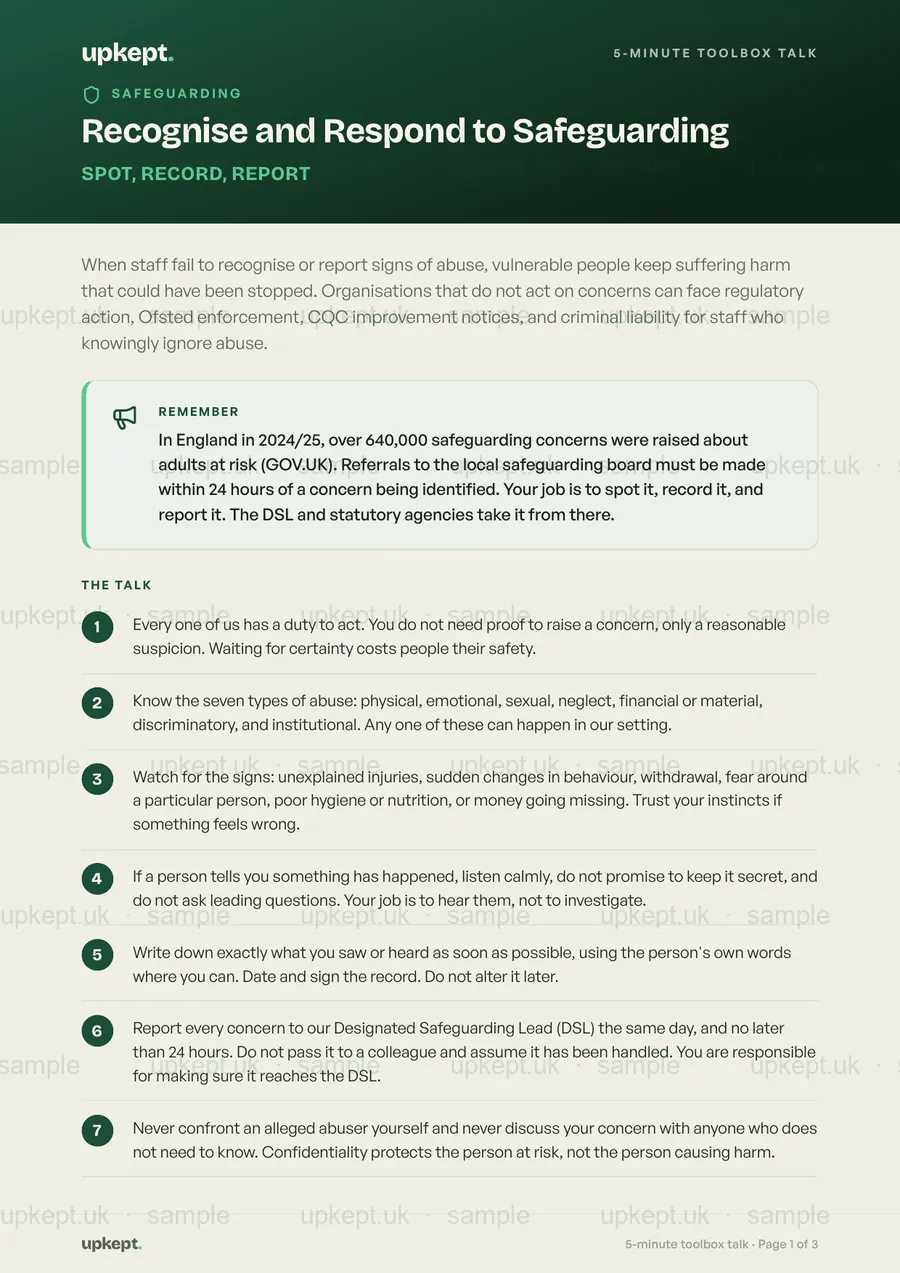
Recognise and Respond to Safeguarding
When staff do not recognise or report the signs of abuse, the person keeps being harmed. Ofsted and CQC both enforce on it, and a worker who knowingly ignores abuse can face criminal liability.
30-day money-back guarantee.
- A script to read out, no prep needed
- Questions to check the team understood
- What the law says, in clear terms
- A printed sign-off sheet, your training record
The talk
What you say, in order.
Read it out as it is, or make it your own. Either way the team hears the same thing, every time.
- 1Every one of us has a duty to act. You do not need proof to raise a concern, only a reasonable suspicion. Waiting for certainty costs people their safety.
- 2Know the seven types of abuse: physical, emotional, sexual, neglect, financial or material, discriminatory, and institutional. Any one of these can happen in our setting.
- 3Watch for the signs: unexplained injuries, sudden changes in behaviour, withdrawal, fear around a particular person, poor hygiene or nutrition, or money going missing. Trust your instincts if something feels wrong.
- 4If a person tells you something has happened, listen calmly, do not promise to keep it secret, and do not ask leading questions. Your job is to hear them, not to investigate.
- 5Write down exactly what you saw or heard as soon as possible, using the person's own words where you can. Date and sign the record. Do not alter it later.
- 6Report every concern to our Designated Safeguarding Lead (DSL) the same day, and no later than 24 hours. Do not pass it to a colleague and assume it has been handled. You are responsible for making sure it reaches the DSL.
- 7Never confront an alleged abuser yourself and never discuss your concern with anyone who does not need to know. Confidentiality protects the person at risk, not the person causing harm.
- 8If you believe someone is in immediate danger, call 999 first, then tell the DSL. The DSL contacts the local authority or children's services from there.
Ask the team
- ?If a service user told you something worrying and then asked you to keep it between the two of you, what would you do and why?
- ?What are the signs you might see that would make you think something is wrong, even if nobody has said anything to you?
- ?Who do you report a concern to, and what is the time limit for doing that?
What the law says
You must report. You must not ignore.
Section 42 of the Care Act 2014 places a legal duty on local authorities to investigate where an adult with care and support needs may be experiencing abuse or neglect. Working Together to Safeguard Children 2023 is the statutory multi-agency framework for child protection, and the EYFS Statutory Framework (Section 3, effective September 2025) sets mandatory safeguarding requirements for all early years providers. Your organisation must have a named Designated Safeguarding Lead, a written policy, and a clear referral pathway to the local Safeguarding Adults Board or Safeguarding Children Partnership.
Source: Care Act 2014 (s.42 to s.47); Working Together to Safeguard Children 2023 (HM Government statutory guidance); Early Years Foundation Stage Statutory Framework 2025 (DfE, Section 3)
Before you buy
Questions people ask first
What is the "Recognise and Respond to Safeguarding" toolbox talk?
When staff do not recognise or report the signs of abuse, the person keeps being harmed. Ofsted and CQC both enforce on it, and a worker who knowingly ignores abuse can face criminal liability.
What does the law say?
You must report. You must not ignore.. Section 42 of the Care Act 2014 places a legal duty on local authorities to investigate where an adult with care and support needs may be experiencing abuse or neglect. Working Together to Safeguard Children 2023 is the statutory multi-agency framework for child protection, and the EYFS Statutory Framework (Section 3, effective September 2025) sets mandatory safeguarding requirements for all early years providers. Your organisation must have a named Designated Safeguarding Lead, a written policy, and a clear referral pathway to the local Safeguarding Adults Board or Safeguarding Children Partnership.
How do I run it, and does it count as training?
Read it out in about five minutes, ask the team the questions, and everyone signs the attendance sheet. That sign-off is your evidence of training under the Health and Safety at Work etc. Act 1974, section 2. Reviewed for October 2026.