Sample pages of the actual document, watermarked. The download is clean.
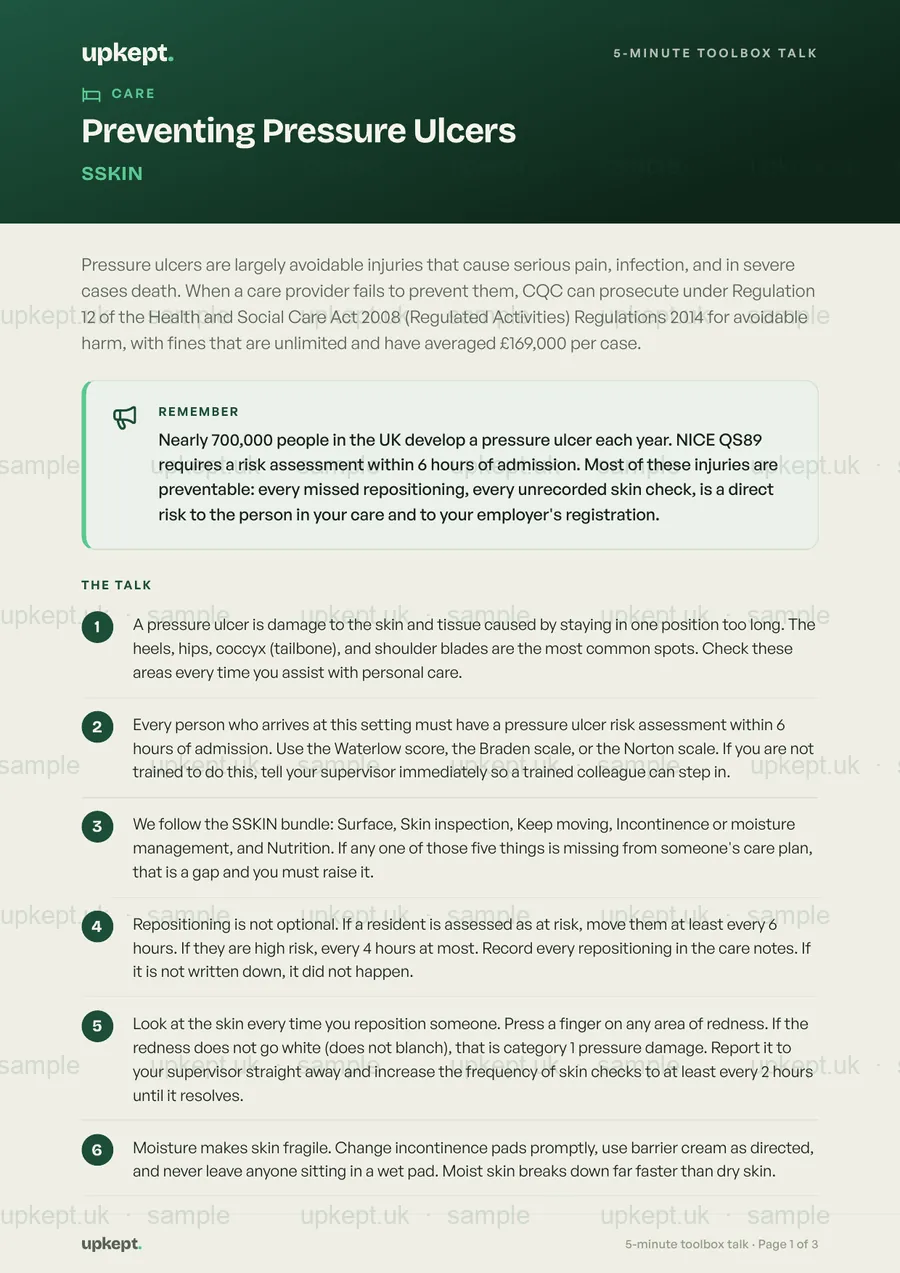
Preventing Pressure Ulcers
Most pressure ulcers are avoidable, and they cause pain, infection and in severe cases death. CQC prosecutes avoidable harm under Regulation 12 of the Health and Social Care Act 2008 (Regulated Activities) Regulations 2014, with fines that have averaged £169,000 per case.
30-day money-back guarantee.
- A script to read out, no prep needed
- Questions to check the team understood
- What the law says, in clear terms
- A printed sign-off sheet, your training record
The talk
What you say, in order.
Read it out as it is, or make it your own. Either way the team hears the same thing, every time.
- 1A pressure ulcer is damage to the skin and tissue caused by staying in one position too long. The heels, hips, coccyx (tailbone), and shoulder blades are the most common spots. Check these areas every time you assist with personal care.
- 2Every person who arrives at this setting must have a pressure ulcer risk assessment within 6 hours of admission. Use the Waterlow score, the Braden scale, or the Norton scale. If you are not trained to do this, tell your supervisor immediately so a trained colleague can step in.
- 3We follow the SSKIN bundle: Surface, Skin inspection, Keep moving, Incontinence or moisture management, and Nutrition. If any one of those five things is missing from someone's care plan, that is a gap and you must raise it.
- 4Repositioning is not optional. If a resident is assessed as at risk, move them at least every 6 hours. If they are high risk, every 4 hours at most. Record every repositioning in the care notes. If it is not written down, it did not happen.
- 5Look at the skin every time you reposition someone. Press a finger on any area of redness. If the redness does not go white (does not blanch), that is category 1 pressure damage. Report it to your supervisor straight away and increase the frequency of skin checks to at least every 2 hours until it resolves.
- 6Moisture makes skin fragile. Change incontinence pads promptly, use barrier cream as directed, and never leave anyone sitting in a wet pad. Moist skin breaks down far faster than dry skin.
- 7Equipment matters. Residents at elevated risk must have a high-specification foam mattress or equivalent pressure-redistributing surface. Wheelchair users need a pressure-redistributing cushion. If a resident's mattress or cushion is damaged or unsuitable, report it now, do not wait until the next inspection.
- 8Malnutrition speeds up pressure damage. If a resident is eating poorly or losing weight, flag it for a dietitian review. Ensure fluid intake is adequate every shift.
Ask the team
- ?If you were repositioning a resident and noticed a patch of redness on their heel that did not go white when you pressed it, what would you do next and who would you tell?
- ?Can anyone name the five steps in the SSKIN bundle, and which one do you think is most often missed on this team?
- ?If a resident arrives or returns from hospital and their skin assessment has not been done, whose responsibility is it to make sure it happens, and how quickly?
What the law says
Avoidable harm is a criminal offence
Under Regulation 12 of the Health and Social Care Act 2008 (Regulated Activities) Regulations 2014, all providers must ensure care is delivered in a way that prevents avoidable harm. CQC can prosecute providers directly, without issuing a warning notice first, if a resident suffers avoidable harm. Fines on conviction are unlimited; average fines in recent years have exceeded £169,000.
Source: Health and Social Care Act 2008 (Regulated Activities) Regulations 2014, Regulation 12; NICE Clinical Guideline CG179 (Pressure ulcers: prevention and management, 2014); NICE Quality Standard QS89 (Pressure ulcers, 2015)
Before you buy
Questions people ask first
What is the "Preventing Pressure Ulcers" toolbox talk?
Most pressure ulcers are avoidable, and they cause pain, infection and in severe cases death. CQC prosecutes avoidable harm under Regulation 12 of the Health and Social Care Act 2008 (Regulated Activities) Regulations 2014, with fines that have averaged £169,000 per case.
What does the law say?
Avoidable harm is a criminal offence. Under Regulation 12 of the Health and Social Care Act 2008 (Regulated Activities) Regulations 2014, all providers must ensure care is delivered in a way that prevents avoidable harm. CQC can prosecute providers directly, without issuing a warning notice first, if a resident suffers avoidable harm. Fines on conviction are unlimited; average fines in recent years have exceeded £169,000.
How do I run it, and does it count as training?
Read it out in about five minutes, ask the team the questions, and everyone signs the attendance sheet. That sign-off is your evidence of training under the Health and Safety at Work etc. Act 1974, section 2. Reviewed for October 2026.