Sample pages of the actual document, watermarked. The download is clean.
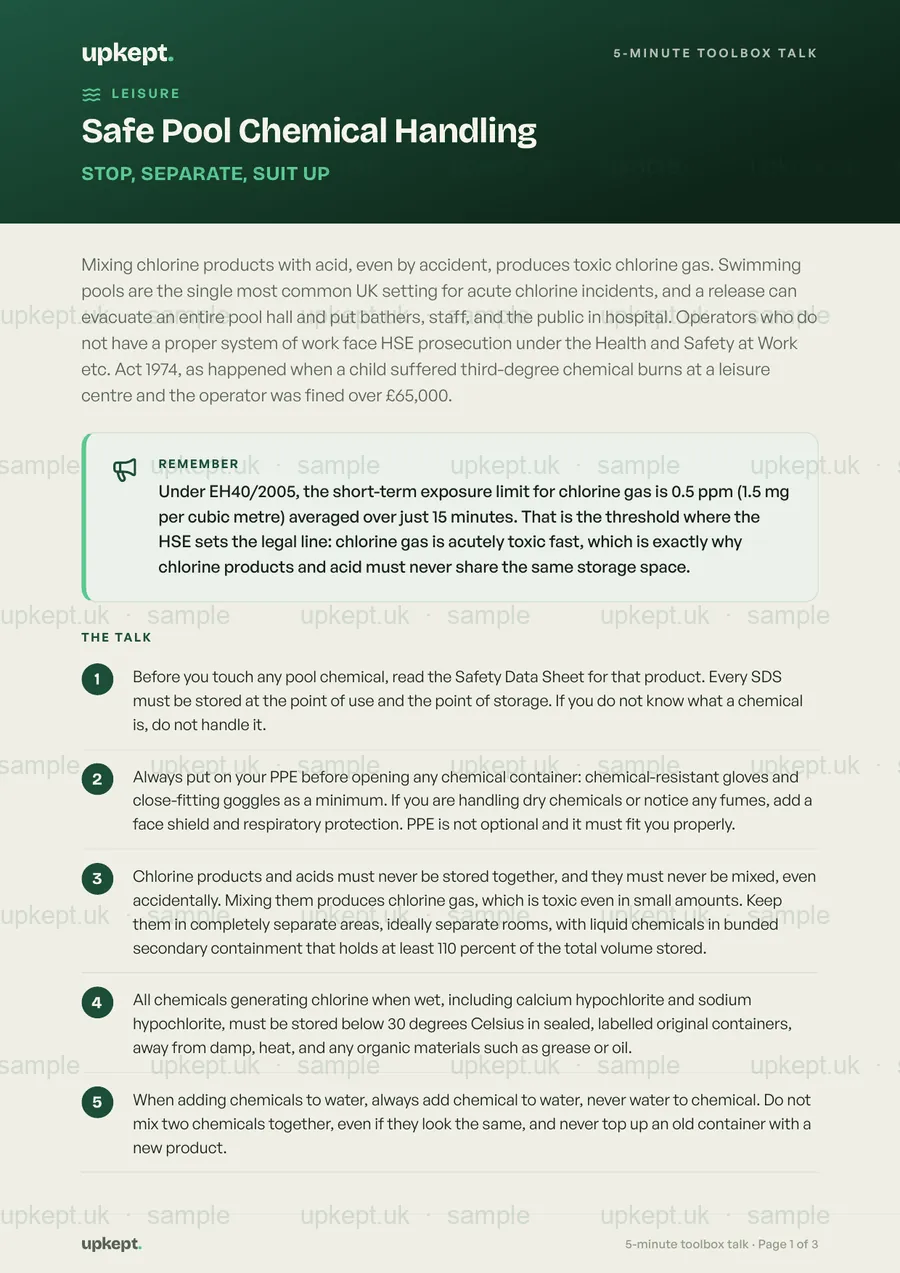
Safe Pool Chemical Handling
Chlorine products mixed with acid, even by accident, give off chlorine gas. Swimming pools are the most common UK setting for acute chlorine incidents, and one release can clear a pool hall into hospital. In one HSE case a child suffered third-degree chemical burns at a leisure centre and the operator was fined over £65,000.
30-day money-back guarantee.
- A script to read out, no prep needed
- Questions to check the team understood
- What the law says, in clear terms
- A printed sign-off sheet, your training record
The talk
What you say, in order.
Read it out as it is, or make it your own. Either way the team hears the same thing, every time.
- 1Before you touch any pool chemical, read the Safety Data Sheet for that product. Every SDS must be stored at the point of use and the point of storage. If you do not know what a chemical is, do not handle it.
- 2Always put on your PPE before opening any chemical container: chemical-resistant gloves and close-fitting goggles as a minimum. If you are handling dry chemicals or notice any fumes, add a face shield and respiratory protection. PPE is not optional and it must fit you properly.
- 3Chlorine products and acids must never be stored together, and they must never be mixed, even accidentally. Mixing them produces chlorine gas, which is toxic even in small amounts. Keep them in completely separate areas, ideally separate rooms, with liquid chemicals in bunded secondary containment that holds at least 110 percent of the total volume stored.
- 4All chemicals generating chlorine when wet, including calcium hypochlorite and sodium hypochlorite, must be stored below 30 degrees Celsius in sealed, labelled original containers, away from damp, heat, and any organic materials such as grease or oil.
- 5When adding chemicals to water, always add chemical to water, never water to chemical. Do not mix two chemicals together, even if they look the same, and never top up an old container with a new product.
- 6After any chemical delivery, check the delivery against the SDS before it is moved to the store. Report any damaged containers, mislabelled drums, or unusual smells to your line manager before storing anything. A chemical you cannot identify stays outside until you know what it is.
- 7If you smell chlorine in the plant room or pool hall, do not investigate alone. Raise the alarm, evacuate the area, and call the emergency services. A chlorine gas release may need to be reported to the HSE under RIDDOR 2013 as a dangerous occurrence. Do not re-enter until the area has been ventilated and cleared by a competent person.
- 8Your employer is legally required under COSHH Regulations 2002 to carry out a COSHH assessment for every pool chemical you handle. If you have not seen a COSHH assessment for your chemicals, or you have not had training on it, raise that today with your supervisor.
Ask the team
- ?If you were in the plant room and smelled chlorine gas, what would you do and in what order?
- ?Can you tell me why we store chlorine products and acid in separate areas, and what happens if they come into contact?
- ?Where would you find the Safety Data Sheet for sodium hypochlorite if you needed to check what PPE to use?
What the law says
Know your chemicals, assess the risk, train your staff
Under the Control of Substances Hazardous to Health Regulations 2002 (COSHH), employers must carry out a suitable and sufficient risk assessment for every hazardous substance handled, provide adequate information, instruction, and training to all staff who handle those substances, and implement control measures to prevent or adequately control exposure. These duties sit on top of the general duty in Section 2 and Section 3 of the Health and Safety at Work etc. Act 1974 to ensure the safety of employees and members of the public. HSE guidance HSG179 (4th edition, 2018) and PWTAG Technical Note 68 set out how these duties apply in practice for pool chemical handling, storage, and delivery.
Source: Control of Substances Hazardous to Health Regulations 2002 (SI 2002/2677) as amended; Health and Safety at Work etc. Act 1974 ss.2-3; HSE HSG179 Managing Health and Safety in Swimming Pools (4th ed, 2018); PWTAG Technical Note 68 (Handling, delivery, storage and application of swimming pool chemicals)
Before you buy
Questions people ask first
What is the "Safe Pool Chemical Handling" toolbox talk?
Chlorine products mixed with acid, even by accident, give off chlorine gas. Swimming pools are the most common UK setting for acute chlorine incidents, and one release can clear a pool hall into hospital. In one HSE case a child suffered third-degree chemical burns at a leisure centre and the operator was fined over £65,000.
What does the law say?
Know your chemicals, assess the risk, train your staff. Under the Control of Substances Hazardous to Health Regulations 2002 (COSHH), employers must carry out a suitable and sufficient risk assessment for every hazardous substance handled, provide adequate information, instruction, and training to all staff who handle those substances, and implement control measures to prevent or adequately control exposure. These duties sit on top of the general duty in Section 2 and Section 3 of the Health and Safety at Work etc. Act 1974 to ensure the safety of employees and members of the public. HSE guidance HSG179 (4th edition, 2018) and PWTAG Technical Note 68 set out how these duties apply in practice for pool chemical handling, storage, and delivery.
How do I run it, and does it count as training?
Read it out in about five minutes, ask the team the questions, and everyone signs the attendance sheet. That sign-off is your evidence of training under the Health and Safety at Work etc. Act 1974, section 2. Reviewed for October 2026.