Sample pages of the actual document, watermarked. The download is clean.
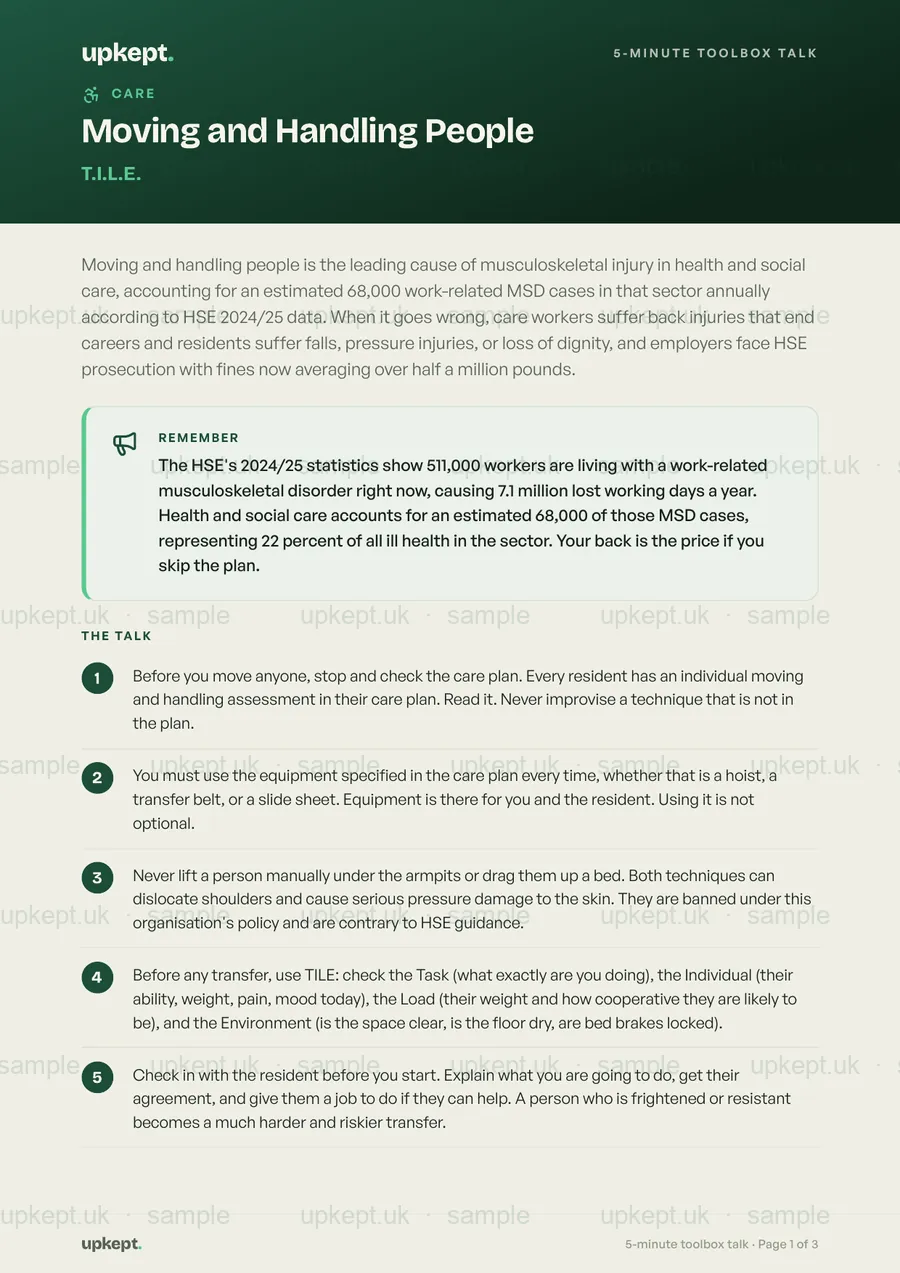
Moving and Handling People
Moving and handling people is the leading cause of musculoskeletal injury in health and social care: an estimated 68,000 work-related MSD cases a year in the sector (HSE 2024/25). A bad lift injures the carer's back and the resident's skin, and HSE fines in the sector now average over half a million pounds.
30-day money-back guarantee.
- A script to read out, no prep needed
- Questions to check the team understood
- What the law says, in clear terms
- A printed sign-off sheet, your training record
The talk
What you say, in order.
Read it out as it is, or make it your own. Either way the team hears the same thing, every time.
- 1Before you move anyone, stop and check the care plan. Every resident has an individual moving and handling assessment in their care plan. Read it. Never improvise a technique that is not in the plan.
- 2You must use the equipment specified in the care plan every time, whether that is a hoist, a transfer belt, or a slide sheet. Equipment is there for you and the resident. Using it is not optional.
- 3Never lift a person manually under the armpits or drag them up a bed. Both techniques can dislocate shoulders and cause serious pressure damage to the skin. They are banned under this organisation's policy and are contrary to HSE guidance.
- 4Before any transfer, use TILE: check the Task (what exactly are you doing), the Individual (their ability, weight, pain, mood today), the Load (their weight and how cooperative they are likely to be), and the Environment (is the space clear, is the floor dry, are bed brakes locked).
- 5Check in with the resident before you start. Explain what you are going to do, get their agreement, and give them a job to do if they can help. A person who is frightened or resistant becomes a much harder and riskier transfer.
- 6Two staff for hoisting unless the care plan says one is sufficient. If you are unsure, get a second person. The few seconds it takes to call for help is always worth it.
- 7Tell your supervisor immediately if something changes: the resident has gained weight, has a new injury, is in pain, or the equipment is damaged. Any change means the assessment needs reviewing before the next transfer.
- 8Under Regulation 5 of the Manual Handling Operations Regulations 1992, you have a legal duty to follow the safe system of work your employer has set out. If you bypass it and someone is hurt, you are personally liable as well as the organisation.
Ask the team
- ?Tell me what you would check before hoisting a resident you have not transferred before.
- ?What would you do if you arrived to do a transfer and the hoist was not working or the sling looked damaged?
- ?Why is it not enough to just ask a resident if they are okay before you move them?
What the law says
Avoid, assess, reduce: it is the law
The Manual Handling Operations Regulations 1992 (SI 1992/2793), Regulation 4, require employers to avoid hazardous manual handling where reasonably practicable, assess any handling that cannot be avoided, and reduce the risk to the lowest level reasonably practicable. Regulation 5 places a matching duty on employees to use the safe system of work provided. The HSE publication HSG225 (Handling Home Care) gives sector-specific guidance on applying this hierarchy in domiciliary and care home settings.
Source: Manual Handling Operations Regulations 1992 (SI 1992/2793); HSE guidance HSG225 Handling Home Care
Before you buy
Questions people ask first
What is the "Moving and Handling People" toolbox talk?
Moving and handling people is the leading cause of musculoskeletal injury in health and social care: an estimated 68,000 work-related MSD cases a year in the sector (HSE 2024/25). A bad lift injures the carer's back and the resident's skin, and HSE fines in the sector now average over half a million pounds.
What does the law say?
Avoid, assess, reduce: it is the law. The Manual Handling Operations Regulations 1992 (SI 1992/2793), Regulation 4, require employers to avoid hazardous manual handling where reasonably practicable, assess any handling that cannot be avoided, and reduce the risk to the lowest level reasonably practicable. Regulation 5 places a matching duty on employees to use the safe system of work provided. The HSE publication HSG225 (Handling Home Care) gives sector-specific guidance on applying this hierarchy in domiciliary and care home settings.
How do I run it, and does it count as training?
Read it out in about five minutes, ask the team the questions, and everyone signs the attendance sheet. That sign-off is your evidence of training under the Health and Safety at Work etc. Act 1974, section 2. Reviewed for October 2026.