Sample pages of the actual document, watermarked. The download is clean.
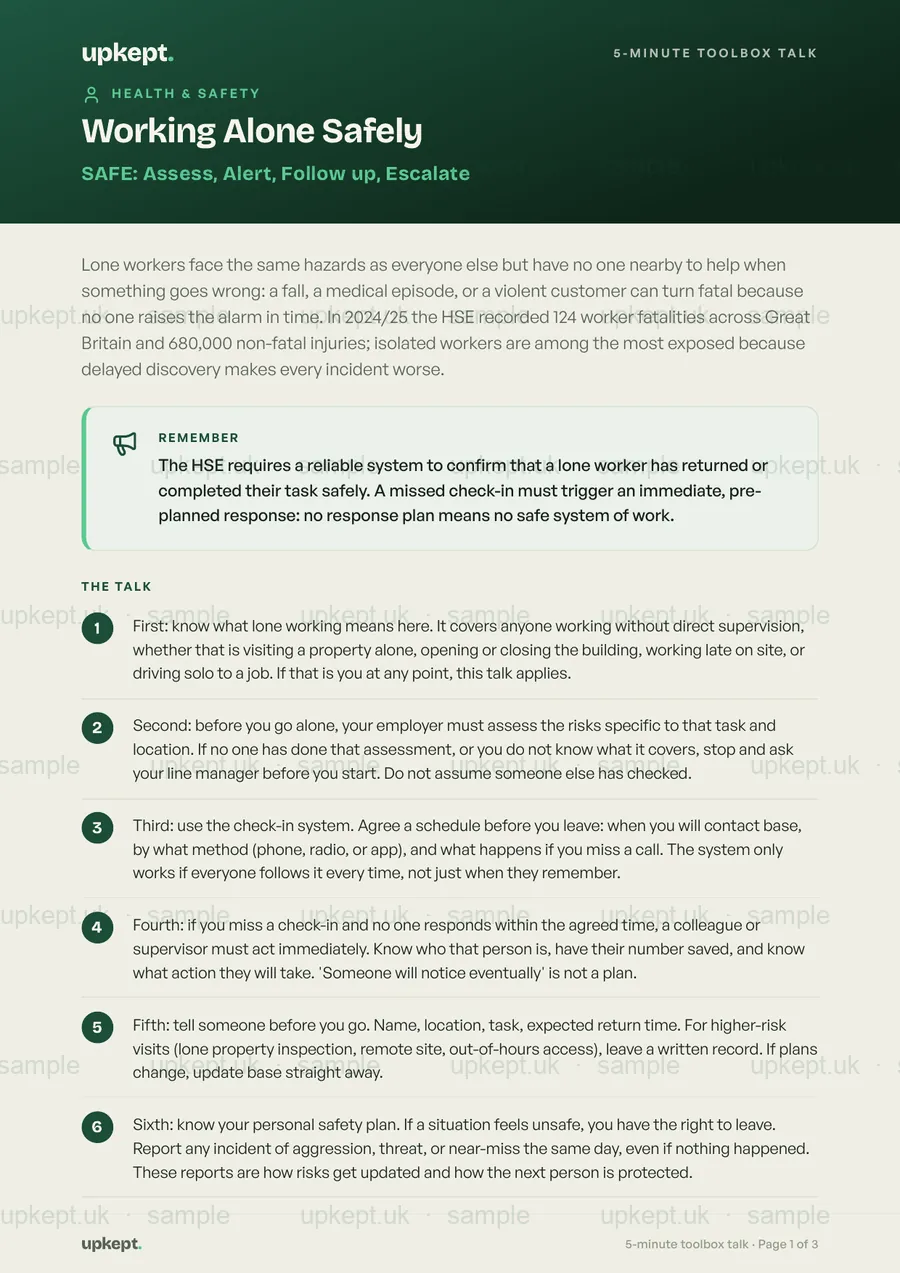
Working Alone Safely
A fall, a medical episode or a violent customer is worse when nobody is nearby to raise the alarm. In 2024/25 the HSE recorded 124 worker fatalities and 680,000 non-fatal injuries in Great Britain; delayed discovery is what makes a lone worker's incident worse.
30-day money-back guarantee.
- A script to read out, no prep needed
- Questions to check the team understood
- What the law says, in clear terms
- A printed sign-off sheet, your training record
The talk
What you say, in order.
Read it out as it is, or make it your own. Either way the team hears the same thing, every time.
- 1First: know what lone working means here. It covers anyone working without direct supervision, whether that is visiting a property alone, opening or closing the building, working late on site, or driving solo to a job. If that is you at any point, this talk applies.
- 2Second: before you go alone, your employer must assess the risks specific to that task and location. If no one has done that assessment, or you do not know what it covers, stop and ask your line manager before you start. Do not assume someone else has checked.
- 3Third: use the check-in system. Agree a schedule before you leave: when you will contact base, by what method (phone, radio, or app), and what happens if you miss a call. The system only works if everyone follows it every time, not just when they remember.
- 4Fourth: if you miss a check-in and no one responds within the agreed time, a colleague or supervisor must act immediately. Know who that person is, have their number saved, and know what action they will take. 'Someone will notice eventually' is not a plan.
- 5Fifth: tell someone before you go. Name, location, task, expected return time. For higher-risk visits (lone property inspection, remote site, out-of-hours access), leave a written record. If plans change, update base straight away.
- 6Sixth: know your personal safety plan. If a situation feels unsafe, you have the right to leave. Report any incident of aggression, threat, or near-miss the same day, even if nothing happened. These reports are how risks get updated and how the next person is protected.
- 7Seventh: medical and fitness to work alone matters. If you have a condition that could make it unsafe to be alone (a seizure disorder, severe allergy, or similar), you must tell your employer. They are legally required to keep that information confidential and to adjust your work, not penalise you.
- 8Eighth: the law puts this duty on your employer, but it only works if you cooperate. Carry your communication device charged and switched on, follow the agreed lone working procedure, and report anything that stops the system working.
Ask the team
- ?What would you actually do if you were alone on site and had an accident that stopped you from using your phone?
- ?Talk me through the check-in process for your role: who do you contact, how often, and who acts if you do not respond?
- ?If a lone working situation felt unsafe when you arrived, what are your options and who would you tell afterwards?
What the law says
Your employer must assess and manage the specific risks of working alone
The Health and Safety at Work etc. Act 1974 (sections 2 and 3) requires every employer to ensure, so far as is reasonably practicable, the health, safety and welfare of their employees and others affected by their work. The Management of Health and Safety at Work Regulations 1999 (regulation 3) make risk assessment a specific legal duty, and for employers with five or more staff that assessment must be recorded in writing. HSE guidance INDG73 (rev4, March 2020) sets out how to meet those duties for lone workers specifically, including training, monitoring, check-in procedures, and protection from work-related violence.
Source: Health and Safety at Work etc. Act 1974; Management of Health and Safety at Work Regulations 1999 (SI 1999/3242); HSE guidance INDG73(rev4) Protecting lone workers: How to manage the risks of working alone
Before you buy
Questions people ask first
What is the "Working Alone Safely" toolbox talk?
A fall, a medical episode or a violent customer is worse when nobody is nearby to raise the alarm. In 2024/25 the HSE recorded 124 worker fatalities and 680,000 non-fatal injuries in Great Britain; delayed discovery is what makes a lone worker's incident worse.
What does the law say?
Your employer must assess and manage the specific risks of working alone. The Health and Safety at Work etc. Act 1974 (sections 2 and 3) requires every employer to ensure, so far as is reasonably practicable, the health, safety and welfare of their employees and others affected by their work. The Management of Health and Safety at Work Regulations 1999 (regulation 3) make risk assessment a specific legal duty, and for employers with five or more staff that assessment must be recorded in writing. HSE guidance INDG73 (rev4, March 2020) sets out how to meet those duties for lone workers specifically, including training, monitoring, check-in procedures, and protection from work-related violence.
How do I run it, and does it count as training?
Read it out in about five minutes, ask the team the questions, and everyone signs the attendance sheet. That sign-off is your evidence of training under the Health and Safety at Work etc. Act 1974, section 2. Reviewed for October 2026.