Sample pages of the actual document, watermarked. The download is clean.
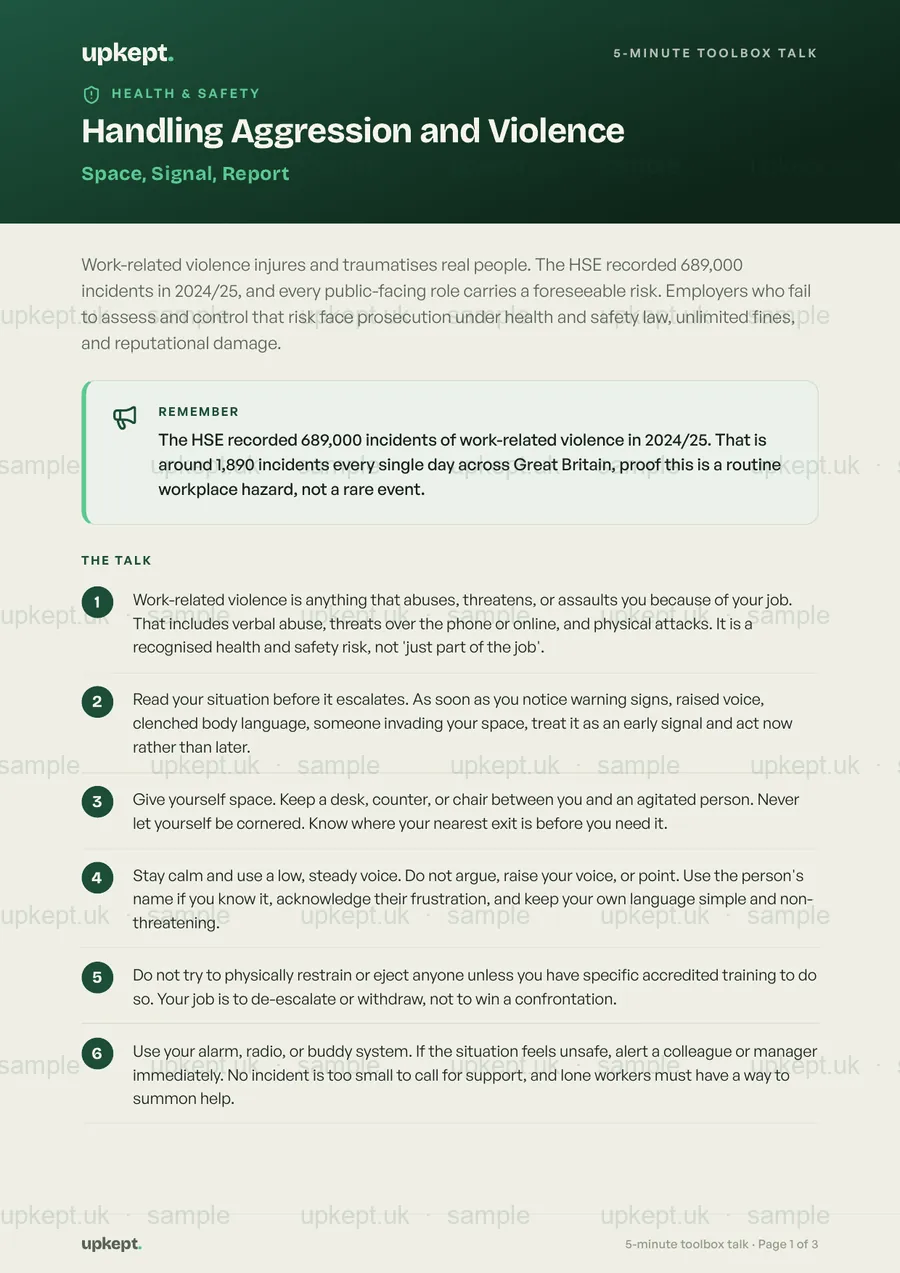
Handling Aggression and Violence
The HSE recorded 689,000 incidents of work-related violence in 2024/25. Every public-facing role carries a foreseeable risk, and the employer's duty is to assess and control it under the Health and Safety at Work etc. Act 1974.
30-day money-back guarantee.
- A script to read out, no prep needed
- Questions to check the team understood
- What the law says, in clear terms
- A printed sign-off sheet, your training record
The talk
What you say, in order.
Read it out as it is, or make it your own. Either way the team hears the same thing, every time.
- 1Work-related violence is anything that abuses, threatens, or assaults you because of your job. That includes verbal abuse, threats over the phone or online, and physical attacks. It is a recognised health and safety risk, not 'just part of the job'.
- 2Read your situation before it escalates. As soon as you notice warning signs, raised voice, clenched body language, someone invading your space, treat it as an early signal and act now rather than later.
- 3Give yourself space. Keep a desk, counter, or chair between you and an agitated person. Never let yourself be cornered. Know where your nearest exit is before you need it.
- 4Stay calm and use a low, steady voice. Do not argue, raise your voice, or point. Use the person's name if you know it, acknowledge their frustration, and keep your own language simple and non-threatening.
- 5Do not try to physically restrain or eject anyone unless you have specific accredited training to do so. Your job is to de-escalate or withdraw, not to win a confrontation.
- 6Use your alarm, radio, or buddy system. If the situation feels unsafe, alert a colleague or manager immediately. No incident is too small to call for support, and lone workers must have a way to summon help.
- 7Report every incident, including verbal threats and near-misses, using our incident log. This is not optional. Reports flag patterns, protect you if the person returns, and give management the data to act. Under RIDDOR, injuries that stop you doing your normal work for more than 7 days must be reported to the HSE.
- 8After any incident, tell your manager straight away. You are entitled to support, including time to recover. There is no expectation that you simply get on with the shift.
Ask the team
- ?If you felt a situation was about to turn aggressive, what would you do first and who would you call?
- ?What are the early warning signs that someone might become violent, and can you give me an example from a role like ours?
- ?Why is it important to report a verbal threat even if nothing physical happened?
What the law says
Employers must protect you from foreseeable violence
Under Section 2 of the Health and Safety at Work etc. Act 1974, your employer must ensure your health, safety, and welfare so far as is reasonably practicable. The Management of Health and Safety at Work Regulations 1999 require a written risk assessment that covers any reasonably foreseeable violence. Where 5 or more people are employed, that assessment must be written down and shared.
Source: Health and Safety at Work etc. Act 1974, s.2; Management of Health and Safety at Work Regulations 1999, reg.3; HSE guidance 'Violence and aggression at work' (hse.gov.uk/violence)
Before you buy
Questions people ask first
What is the "Handling Aggression and Violence" toolbox talk?
The HSE recorded 689,000 incidents of work-related violence in 2024/25. Every public-facing role carries a foreseeable risk, and the employer's duty is to assess and control it under the Health and Safety at Work etc. Act 1974.
What does the law say?
Employers must protect you from foreseeable violence. Under Section 2 of the Health and Safety at Work etc. Act 1974, your employer must ensure your health, safety, and welfare so far as is reasonably practicable. The Management of Health and Safety at Work Regulations 1999 require a written risk assessment that covers any reasonably foreseeable violence. Where 5 or more people are employed, that assessment must be written down and shared.
How do I run it, and does it count as training?
Read it out in about five minutes, ask the team the questions, and everyone signs the attendance sheet. That sign-off is your evidence of training under the Health and Safety at Work etc. Act 1974, section 2. Reviewed for October 2026.