Sample pages of the actual document, watermarked. The download is clean.
Colour-Coded Cleaning
The wrong mop in the wrong area carries E. coli, norovirus and C. difficile from the toilets into the kitchen or the clinical area. The colour code is the control, and a breach of it is a hygiene control failure under UK food and health legislation.
30-day money-back guarantee.
- A script to read out, no prep needed
- Questions to check the team understood
- What the law says, in clear terms
- A printed sign-off sheet, your training record
The talk
What you say, in order.
Read it out as it is, or make it your own. Either way the team hears the same thing, every time.
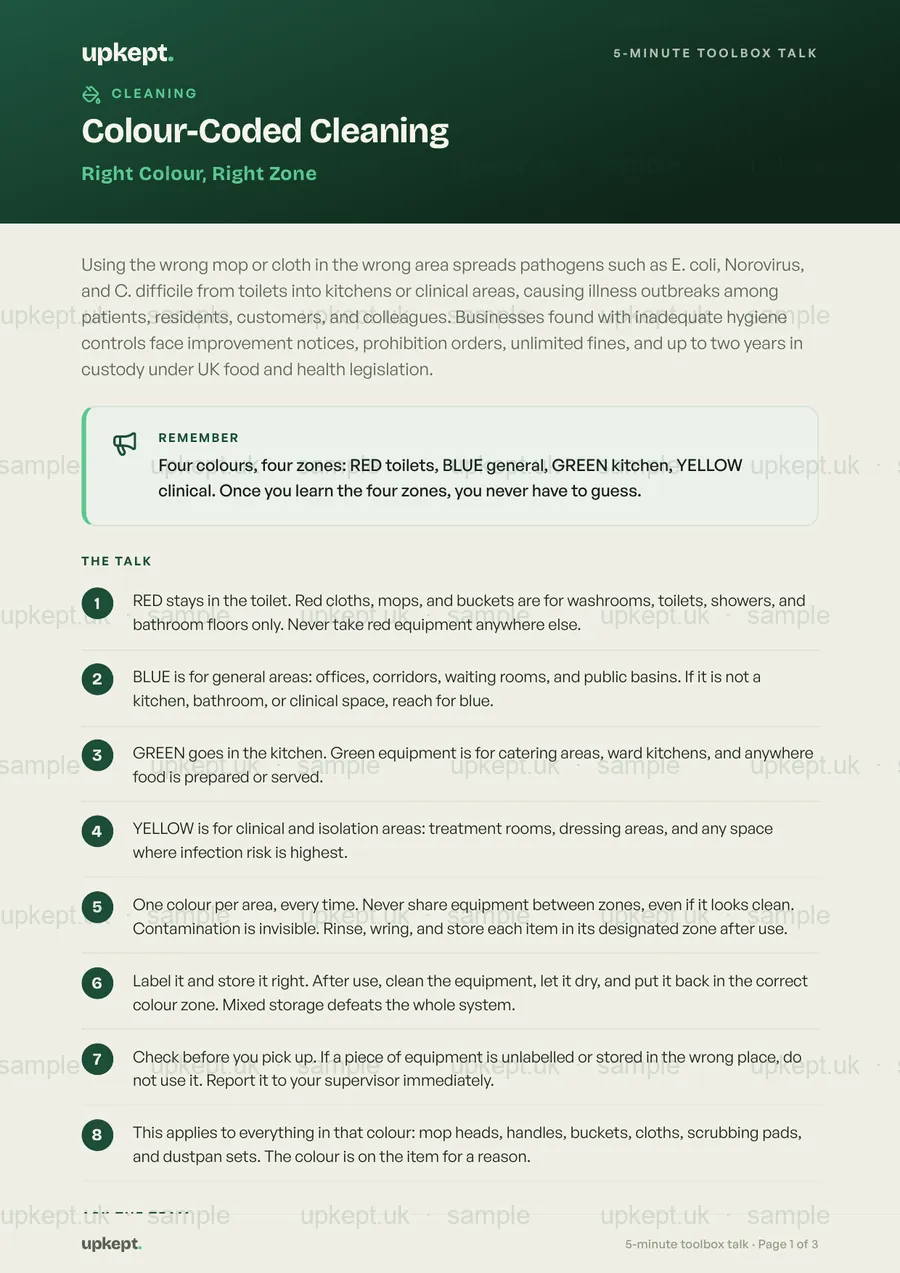
- 1RED stays in the toilet. Red cloths, mops, and buckets are for washrooms, toilets, showers, and bathroom floors only. Never take red equipment anywhere else.
- 2BLUE is for general areas: offices, corridors, waiting rooms, and public basins. If it is not a kitchen, bathroom, or clinical space, reach for blue.
- 3GREEN goes in the kitchen. Green equipment is for catering areas, ward kitchens, and anywhere food is prepared or served.
- 4YELLOW is for clinical and isolation areas: treatment rooms, dressing areas, and any space where infection risk is highest.
- 5One colour per area, every time. Never share equipment between zones, even if it looks clean. Contamination is invisible. Rinse, wring, and store each item in its designated zone after use.
- 6Label it and store it right. After use, clean the equipment, let it dry, and put it back in the correct colour zone. Mixed storage defeats the whole system.
- 7Check before you pick up. If a piece of equipment is unlabelled or stored in the wrong place, do not use it. Report it to your supervisor immediately.
- 8This applies to everything in that colour: mop heads, handles, buckets, cloths, scrubbing pads, and dustpan sets. The colour is on the item for a reason.
Ask the team
- ?Can you tell me which colour you would use to clean the staff kitchen, and why you would not use anything else in there?
- ?What would you do if you arrived for your shift and found a red mop stored in the kitchen cleaning cupboard?
- ?Why does it matter that the mop head and the bucket are the same colour?
What the law says
Keep it clean, keep it separate
The Health and Social Care Act 2008 Code of Practice on the Prevention and Control of Infections (updated 2015) requires registered providers to maintain appropriate standards of hygiene, including correct segregation of cleaning equipment. In food settings, Retained UK Law Regulation (EC) 852/2004 (now UK Regulation 852/2004) requires food business operators to keep premises and equipment clean and to prevent contamination; a breach can result in an improvement notice, a prohibition order, or prosecution under the Food Safety and Hygiene (England) Regulations 2013 SI 2013/2996, which carry fines up to unlimited in the Crown Court. CQC inspections for regulated care providers check for evidence of colour-coded cleaning as part of compliance with Regulation 12(2)(h) and Regulation 15 of the Health and Social Care Act 2008 (Regulated Activities) Regulations 2014.
Source: Health and Social Care Act 2008 Code of Practice on Infection Prevention and Control (DHSC, 2015); UK Regulation 852/2004 on hygiene of foodstuffs; Food Safety and Hygiene (England) Regulations 2013 SI 2013/2996; Health and Social Care Act 2008 (Regulated Activities) Regulations 2014 Reg. 12 and 15; NHS National Standards of Healthcare Cleanliness 2025 (NHS England); BICSc National Colour Coding Scheme
Before you buy
Questions people ask first
What is the "Colour-Coded Cleaning" toolbox talk?
The wrong mop in the wrong area carries E. coli, norovirus and C. difficile from the toilets into the kitchen or the clinical area. The colour code is the control, and a breach of it is a hygiene control failure under UK food and health legislation.
What does the law say?
Keep it clean, keep it separate. The Health and Social Care Act 2008 Code of Practice on the Prevention and Control of Infections (updated 2015) requires registered providers to maintain appropriate standards of hygiene, including correct segregation of cleaning equipment. In food settings, Retained UK Law Regulation (EC) 852/2004 (now UK Regulation 852/2004) requires food business operators to keep premises and equipment clean and to prevent contamination; a breach can result in an improvement notice, a prohibition order, or prosecution under the Food Safety and Hygiene (England) Regulations 2013 SI 2013/2996, which carry fines up to unlimited in the Crown Court. CQC inspections for regulated care providers check for evidence of colour-coded cleaning as part of compliance with Regulation 12(2)(h) and Regulation 15 of the Health and Social Care Act 2008 (Regulated Activities) Regulations 2014.
How do I run it, and does it count as training?
Read it out in about five minutes, ask the team the questions, and everyone signs the attendance sheet. That sign-off is your evidence of training under the Health and Safety at Work etc. Act 1974, section 2. Reviewed for October 2026.