Sample pages of the actual document, watermarked. The download is clean.
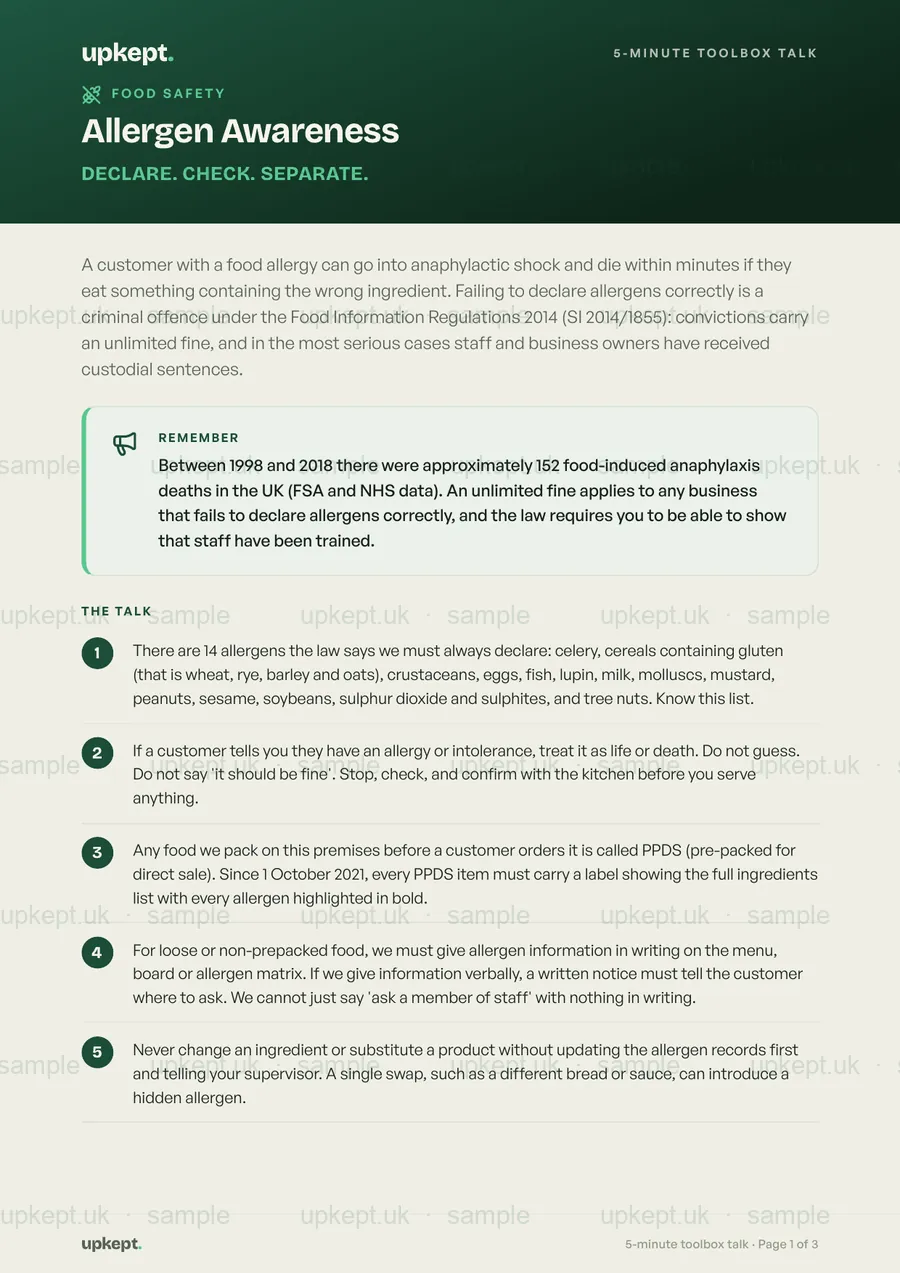
Allergen Awareness
A customer with a food allergy can go into anaphylactic shock within minutes of eating the wrong ingredient. Giving false allergen information is an offence under the Food Information Regulations 2014 (SI 2014/1855) with an unlimited fine, and business owners have been imprisoned after a death.
30-day money-back guarantee.
- A script to read out, no prep needed
- Questions to check the team understood
- What the law says, in clear terms
- A printed sign-off sheet, your training record
The talk
What you say, in order.
Read it out as it is, or make it your own. Either way the team hears the same thing, every time.
- 1There are 14 allergens the law says we must always declare: celery, cereals containing gluten (that is wheat, rye, barley and oats), crustaceans, eggs, fish, lupin, milk, molluscs, mustard, peanuts, sesame, soybeans, sulphur dioxide and sulphites, and tree nuts. Know this list.
- 2If a customer tells you they have an allergy or intolerance, treat it as life or death. Do not guess. Do not say 'it should be fine'. Stop, check, and confirm with the kitchen before you serve anything.
- 3Any food we pack on this premises before a customer orders it is called PPDS (pre-packed for direct sale). Since 1 October 2021, every PPDS item must carry a label showing the full ingredients list with every allergen highlighted in bold.
- 4For loose or non-prepacked food, we must give allergen information in writing on the menu, board or allergen matrix. If we give information verbally, a written notice must tell the customer where to ask. We cannot just say 'ask a member of staff' with nothing in writing.
- 5Never change an ingredient or substitute a product without updating the allergen records first and telling your supervisor. A single swap, such as a different bread or sauce, can introduce a hidden allergen.
- 6Cross-contamination is a real risk. Use separate utensils and clean surfaces thoroughly when preparing food for an allergic customer. If you cannot guarantee separation, tell the customer honestly.
- 7If you are not sure whether a dish contains an allergen, say so clearly and offer to find out. An honest 'I need to check' is always safer than a confident wrong answer.
- 8Sign the attendance sheet at the end of this talk. Your signature confirms you have received allergen awareness training today, which is a requirement the business must be able to demonstrate to enforcement officers.
Ask the team
- ?Can someone name three of the 14 allergens we must declare? And which three do you think come up most often in our kitchen?
- ?A customer says they are allergic to nuts and asks if a dish is safe. What exactly would you do, step by step, before you serve them?
- ?Where can customers on this site find written allergen information right now, and what would you do if that information was out of date or missing?
What the law says
Declare all 14 allergens, every time, in writing
The Food Information Regulations 2014 (SI 2014/1855) require every food business to provide accurate allergen information for all food sold, whether prepacked, loose or pre-packed for direct sale. Natasha's Law (the Food Information (Amendment) (England) Regulations 2019, in force 1 October 2021) extended this by requiring PPDS food to carry a full ingredients list with allergens emphasised. Breaching these requirements is a criminal offence carrying an unlimited fine; prosecutions have resulted in custodial sentences.
Source: Food Information Regulations 2014, SI 2014/1855; Food Information (Amendment) (England) Regulations 2019 (SI 2019/529); FSA Allergen Guidance for Food Businesses (updated March 2025)
Before you buy
Questions people ask first
What is the "Allergen Awareness" toolbox talk?
A customer with a food allergy can go into anaphylactic shock within minutes of eating the wrong ingredient. Giving false allergen information is an offence under the Food Information Regulations 2014 (SI 2014/1855) with an unlimited fine, and business owners have been imprisoned after a death.
What does the law say?
Declare all 14 allergens, every time, in writing. The Food Information Regulations 2014 (SI 2014/1855) require every food business to provide accurate allergen information for all food sold, whether prepacked, loose or pre-packed for direct sale. Natasha's Law (the Food Information (Amendment) (England) Regulations 2019, in force 1 October 2021) extended this by requiring PPDS food to carry a full ingredients list with allergens emphasised. Breaching these requirements is a criminal offence carrying an unlimited fine; prosecutions have resulted in custodial sentences.
How do I run it, and does it count as training?
Read it out in about five minutes, ask the team the questions, and everyone signs the attendance sheet. That sign-off is your evidence of training under the Health and Safety at Work etc. Act 1974, section 2. Reviewed for October 2026.