Sample pages of the actual document, watermarked. The download is clean.
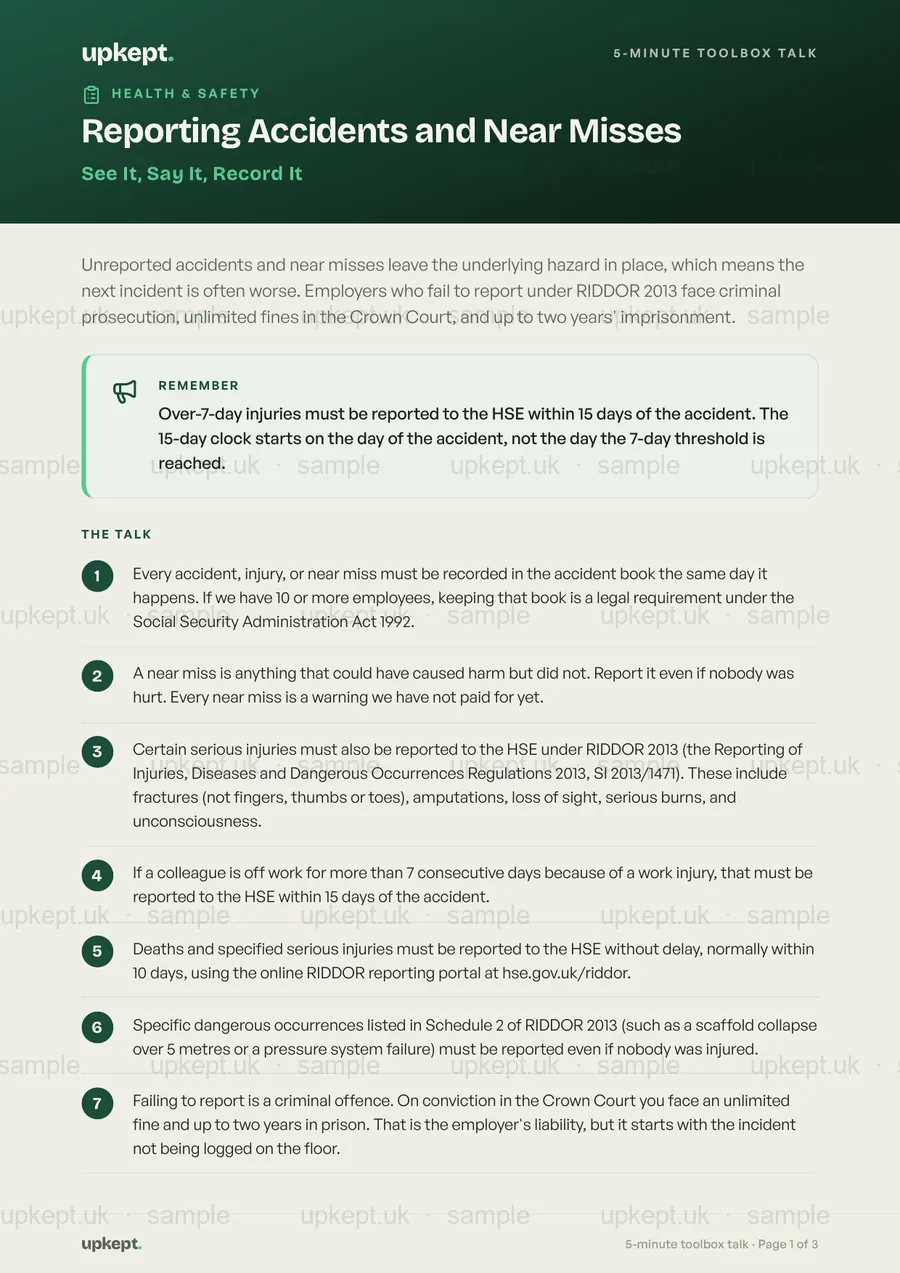
Reporting Accidents and Near Misses
An unreported near miss leaves the hazard in place for the next person. RIDDOR 2013 sets which incidents must be reported to the HSE and by when, and failing to report is a criminal offence.
30-day money-back guarantee.
- A script to read out, no prep needed
- Questions to check the team understood
- What the law says, in clear terms
- A printed sign-off sheet, your training record
The talk
What you say, in order.
Read it out as it is, or make it your own. Either way the team hears the same thing, every time.
- 1Every accident, injury, or near miss must be recorded in the accident book the same day it happens. If we have 10 or more employees, keeping that book is a legal requirement under the Social Security Administration Act 1992.
- 2A near miss is anything that could have caused harm but did not. Report it even if nobody was hurt. Every near miss is a warning we have not paid for yet.
- 3Certain serious injuries must also be reported to the HSE under RIDDOR 2013 (the Reporting of Injuries, Diseases and Dangerous Occurrences Regulations 2013, SI 2013/1471). These include fractures (not fingers, thumbs or toes), amputations, loss of sight, serious burns, and unconsciousness.
- 4If a colleague is off work for more than 7 consecutive days because of a work injury, that must be reported to the HSE within 15 days of the accident.
- 5Deaths and specified serious injuries must be reported to the HSE without delay, normally within 10 days, using the online RIDDOR reporting portal at hse.gov.uk/riddor.
- 6Specific dangerous occurrences listed in Schedule 2 of RIDDOR 2013 (such as a scaffold collapse over 5 metres or a pressure system failure) must be reported even if nobody was injured.
- 7Failing to report is a criminal offence. On conviction in the Crown Court you face an unlimited fine and up to two years in prison. That is the employer's liability, but it starts with the incident not being logged on the floor.
- 8Never feel pressure not to report. Your job is to tell your supervisor or the responsible person straight away. There is no blame for reporting; there is risk for staying silent.
Ask the team
- ?If you saw a pallet fall from a racking bay and it nearly hit a colleague but nobody was hurt, what would you do and who would you tell?
- ?Can anyone tell me what the time limit is for reporting a RIDDOR over-7-day injury to the HSE, and when the clock starts?
- ?What types of injury or event do you think would need to be reported to the HSE, not just logged in our accident book?
What the law says
Report it, record it, keep it
RIDDOR 2013 (SI 2013/1471) requires the responsible person to report specified injuries, over-7-day injuries, occupational diseases, and dangerous occurrences to the HSE. Records must be kept for at least 3 years from the date of the incident. Breach is a criminal offence carrying unlimited fines and up to 2 years' imprisonment under the Health and Safety at Work etc. Act 1974.
Source: Reporting of Injuries, Diseases and Dangerous Occurrences Regulations 2013 (SI 2013/1471); Health and Safety at Work etc. Act 1974; Social Security Administration Act 1992 (accident book requirement)
Before you buy
Questions people ask first
What is the "Reporting Accidents and Near Misses" toolbox talk?
An unreported near miss leaves the hazard in place for the next person. RIDDOR 2013 sets which incidents must be reported to the HSE and by when, and failing to report is a criminal offence.
What does the law say?
Report it, record it, keep it. RIDDOR 2013 (SI 2013/1471) requires the responsible person to report specified injuries, over-7-day injuries, occupational diseases, and dangerous occurrences to the HSE. Records must be kept for at least 3 years from the date of the incident. Breach is a criminal offence carrying unlimited fines and up to 2 years' imprisonment under the Health and Safety at Work etc. Act 1974.
How do I run it, and does it count as training?
Read it out in about five minutes, ask the team the questions, and everyone signs the attendance sheet. That sign-off is your evidence of training under the Health and Safety at Work etc. Act 1974, section 2. Reviewed for October 2026.